Amazon's Dynamo
Why this paper matters
The Dynamo paper (DeCandia et al., 2007) is a foundational document in the evolution of distributed databases, marking a decisive shift from ACID-heavy transactional systems toward eventually consistent, highly available designs optimized for internet-scale workloads. At the time of publication, most large-scale systems relied on strong consistency models derived from relational database theory, but Amazon’s operational reality-tens of thousands of servers across global datacenters with continuous partial failures-demanded a radical rethinking. Dynamo introduced a pragmatic, anti-fragile approach to state management: accept temporary inconsistency to preserve availability and partition tolerance, a stance later formalized as the AP side of the CAP theorem. This paper did not merely describe a system; it catalyzed a movement, influencing generations of NoSQL databases and shaping how modern distributed systems balance correctness, latency, and fault tolerance.
By demonstrating that eventual consistency could coexist with high availability in production at Amazon’s scale, Dynamo validated the hypothesis that application-level conflict resolution and vector clocks could replace synchronous coordination. It also introduced key abstractions-consistent hashing for load distribution, sloppy quorums for failure handling, and merkle trees for anti-entropy-that became staples in later systems. More than a technical artifact, Dynamo redefined the contract between storage systems and applications, arguing that developers-not databases-should own correctness semantics. This inversion of responsibility has had lasting implications, from microservices architectures to modern serverless platforms. It also paved the way for later debates about the limits of distributed transactions, as articulated in Pat Helland’s influential Life Beyond Distributed Transactions: An Apostate’s Opinion, which frames Dynamo as a turning point in distributed systems design.
Key contributions
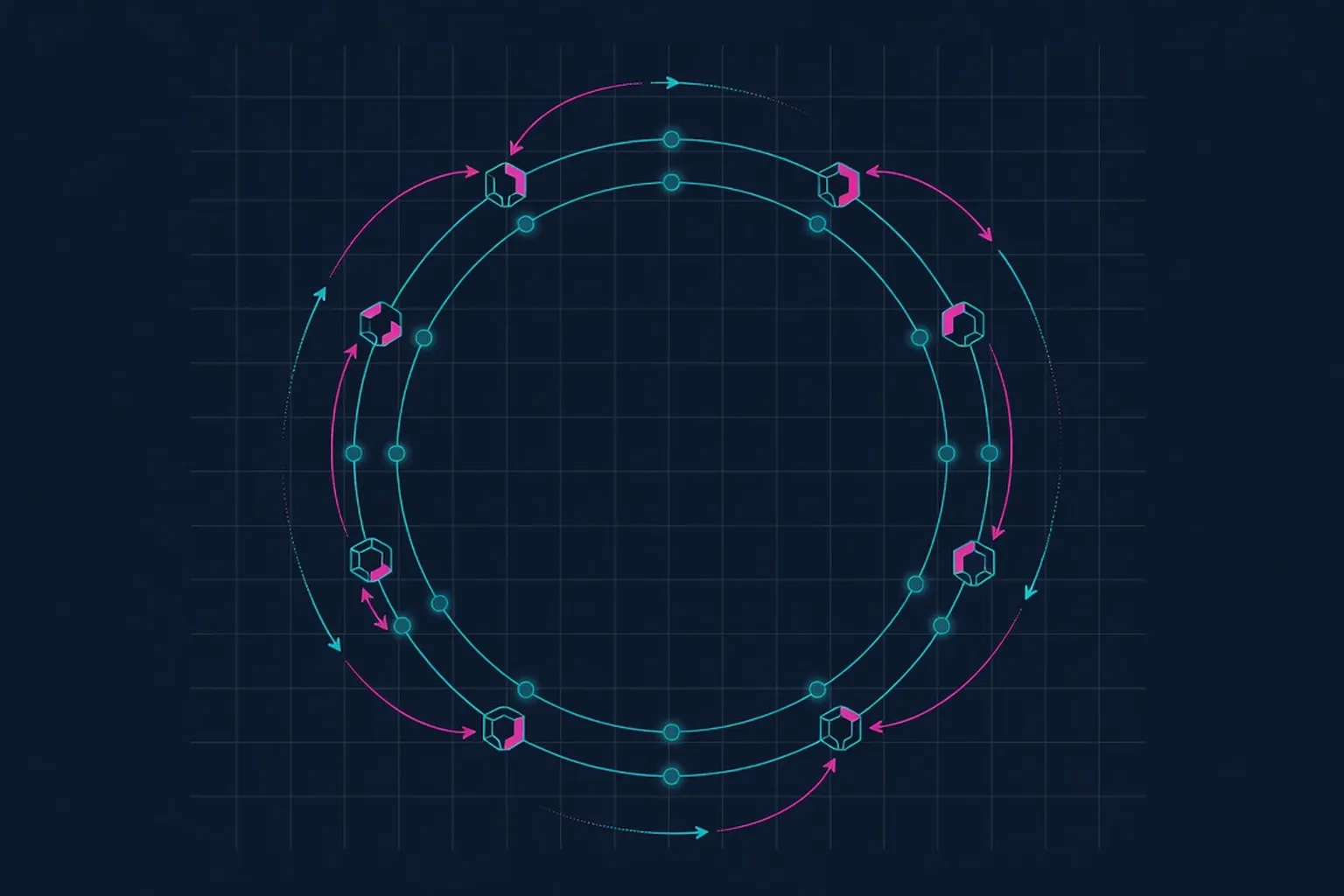
- Consistent hashing with virtual nodes: A scalable, decentralized key distribution mechanism that minimizes reorganization during node churn and enables uniform load balancing across a large cluster.
- Sloppy quorum and hinted handoff: A probabilistic consistency model that relaxes quorum requirements during failures, using temporary delegation to surviving nodes and replaying hints once recovery occurs-preserving availability without sacrificing durability.
- Vector-clock-based versioning and conflict resolution: A metadata-rich approach to tracking causality across distributed updates, enabling applications to detect and resolve concurrent modifications without requiring synchronous coordination.
- Gossip-based membership and failure detection: A lightweight, symmetric protocol for disseminating node state across the cluster, avoiding centralized coordinators and improving resilience to network partitions.
- Merkle tree anti-entropy: A cryptographic mechanism for detecting divergent replicas and efficiently synchronizing divergent states without full data transfers, reducing network overhead during recovery.
- Declarative interface and application-level semantics: A key-value API that exposes versioning and conflict handling to developers, shifting responsibility for correctness from the database to the application layer.
Impact on modern systems
Dynamo’s architectural blueprint has been directly replicated and extended in numerous modern distributed databases, embedding its core ideas into production-grade systems that power today’s web-scale applications.
Apache Cassandra, originally developed at Facebook and inspired explicitly by Dynamo, adopted consistent hashing, sloppy quorums, and tunable consistency levels, becoming the de facto standard for time-series, messaging, and content management platforms. Cassandra’s use of virtual nodes (vnodes) in production since 2011 directly descends from Dynamo’s virtual node concept, enabling horizontal scalability across thousands of nodes with minimal rebalancing overhead. Unlike Dynamo, Cassandra refined hinted handoff semantics to be more deterministic and incorporated support for secondary indexes and materialized views, but its replication and failure-handling core remain unmistakably Dynamo-derived. Facebook’s production usage of Cassandra at petabyte scale-supporting inbox search and messaging-demonstrates how Dynamo’s principles scale beyond e-commerce to social networking workloads.
ScyllaDB, a C++ reimplementation of Cassandra designed for millisecond-scale tail latency, pushes Dynamo’s ideas further by eliminating Java’s garbage collection pauses and optimizing network stacks. ScyllaDB’s shard-per-core architecture and shared-nothing design reflect Dynamo’s partition-aware request routing, while its use of atomic counters and lightweight transactions shows how eventual consistency can coexist with bounded staleness guarantees in practice. In production environments, ScyllaDB has demonstrated single-digit millisecond p99 latencies at scales exceeding 1 million writes per second per cluster, validating Dynamo’s thesis that availability and low latency can be achieved without sacrificing correctness-when engineered carefully. Its integration with Kubernetes and cloud-native orchestration further extends Dynamo’s operational ethos into modern containerized environments. Notably, ScyllaDB’s adoption of the LSM-tree storage engine for write-heavy workloads demonstrates how Dynamo’s principles can be combined with modern storage techniques to achieve both durability and performance at scale.
Dynamo’s influence extends beyond NoSQL. FoundationDB, now a core storage engine behind Apple Cloud services, blends strong consistency with distributed design by using a deterministic transaction protocol over a partitioned, ordered key space. Its layered architecture separates stateless transaction processing from stateful storage, a clean separation that echoes Dynamo’s modularity and allows it to scale independently-a lesson drawn from managing large-scale infrastructure. Similarly, Amazon DynamoDB, launched in 2012, is a managed reinterpretation of Dynamo’s principles, offering configurable consistency models and automatic sharding while abstracting away operational complexity for developers. DynamoDB’s adoption of partitioned tables and eventual consistency in global tables directly reflects Dynamo’s original design goals, showing how the paper’s ideas permeated even the largest cloud platforms.
The paper also catalyzed a broader architectural shift toward disaggregated, microservice-friendly data layers. Systems like CockroachDB and YugabyteDB adopt Dynamo’s decentralized spirit but enforce strong consistency via Raft-based consensus, illustrating how modern systems navigate the tension between availability and correctness by combining consensus protocols with partitioned designs. These systems often cite Dynamo as a motivating counterexample to monolithic transactional databases, even when they ultimately choose ACID as the default. The 2007 paper Life Beyond Distributed Transactions: An Apostate’s Opinion by Pat Helland, a contemporary of Dynamo’s authors, frames this shift philosophically-Dynamo provided the empirical proof that the old consensus-centric worldview was insufficient for the internet scale.
Even PostgreSQL, through extensions like pg_cron and logical replication, has absorbed elements of Dynamo’s operational ethos: eventual consistency in logical replication slots, anti-entropy via checksum-based comparison, and application-level conflict resolution via custom conflict handlers. While not a direct port, PostgreSQL’s evolution toward distributed capabilities reflects the same pragmatic pressure that led to Dynamo’s design. Its adoption of quorum-based synchronous replication and parallel logical decoding further bridges the gap between relational and NoSQL paradigms, showing how Dynamo’s ideas have permeated even traditionally ACID-centric systems. The rise of logical decoding in PostgreSQL 10+, for instance, enables downstream consumers to maintain their own replicas with application-defined conflict resolution-mirroring Dynamo’s core tenet of pushing reconciliation logic to the edges.
AI era: how LLMs and vector databases relate to this paper
The rise of large language models (LLMs) and vector databases has resurrected and repurposed many of Dynamo’s core ideas, particularly in the context of stateful, distributed AI systems. Vector databases like Pinecone, Weaviate, Qdrant, and pgvector are effectively distributed key-value stores specialized for high-dimensional vector similarity search-yet they inherit challenges of scale, availability, and consistency that mirror Dynamo’s original domain.
Vector embeddings introduce a new kind of “state” that must be versioned, sharded, and reconciled across replicas. Just as Dynamo used vector clocks to track causality among concurrent writes, modern vector databases employ causal timestamps and hybrid logical clocks to resolve conflicts arising from overlapping updates to the same semantic index. For example, Qdrant supports point-level vector updates with optimistic concurrency control, allowing applications to specify vector versions during upserts-exactly the kind of application-assisted conflict resolution Dynamo pioneered. This enables multi-tenant AI services to maintain consistent semantic indexes even when multiple users or agents update overlapping regions of the embedding space concurrently. Similarly, Milvus implements a “grow-only” version vector for each entity, ensuring that concurrent updates can be merged deterministically without blocking, a direct operationalization of Dynamo’s vector clock concept.
In Retrieval-Augmented Generation (RAG) systems, the vector index acts as a dynamic knowledge store that must stay available even under node failures or network partitions. Many RAG pipelines deploy multiple vector store replicas using Dynamo-style gossip protocols to propagate membership and failure states. This ensures that during inference, queries can be routed to the nearest available replica, reducing LLM latency-a critical factor in real-time AI agents. Pinecone, for instance, uses a distributed architecture inspired by Dynamo’s consistent hashing to partition vector indexes, enabling global scale with single-digit millisecond read latencies despite eventual consistency during transient failures. Its managed service model abstracts away the operational complexity of running Dynamo-like clusters, making the approach accessible to AI practitioners without deep distributed systems expertise. Weaviate, another leading vector database, similarly employs a decentralized architecture where each shard maintains its own membership view via gossip, allowing the system to dynamically rebalance under load while preserving availability.
Semantic indexes further amplify the need for conflict detection and resolution. When multiple agents or services update the same entity embedding concurrently-for instance, a chatbot updating a user’s vectorized profile based on recent interactions-vector databases must detect divergence and merge states. This process relies on application logic (e.g., weighted averaging, recency scoring) to resolve conflicts, mirroring Dynamo’s design of pushing reconciliation to the application layer. Tools like Milvus implement this through a combination of vector versioning and metadata tags, effectively operationalizing Dynamo’s vector clock idea in the AI context. In production, this enables systems like autonomous customer support agents to maintain coherent long-term memory across sessions, even when updates arrive out of order or from multiple sources. For example, a customer service bot might update a user’s interaction history while simultaneously logging sentiment analysis results-both operations must be reconciled without blocking, a scenario Dynamo anticipated two decades ago.
LLM inference itself introduces stateful, long-running interactions that require persistent, distributed state stores. AI agents that maintain memory across sessions increasingly use vector databases as semantic state backends, storing embeddings of conversation context or task state. These systems must handle partial failures, retries, and eventual consistency-precisely the conditions Dynamo was built to tolerate. For instance, LangChain’s integrations with vector stores often assume eventual convergence, allowing the agent’s reasoning loop to proceed even if one replica is temporarily unreachable. This design aligns with Dynamo’s philosophy of embracing partial failure as a first-class concern rather than an edge case. In practice, this means that an AI agent querying a vector store for context may receive slightly stale but still useful data during a partition, rather than failing outright-a tradeoff Dynamo demonstrated was acceptable for user-facing workloads.
The tension between latency and correctness in Dynamo echoes in today’s AI serving systems. High-throughput LLM inference requires low-latency access to embeddings and context, but strong consistency would introduce synchronous coordination and latency spikes. Many modern AI platforms therefore adopt tunable consistency levels-similar to Dynamo’s quorum tuning-balancing accuracy with performance. For example, Weaviate allows configuring consistency modes per query, enabling “read-your-writes” semantics during critical inference steps while relaxing guarantees elsewhere. This mirrors Dynamo’s support for tunable consistency in Amazon’s own services, where developers can choose between strong and eventual consistency based on workload demands. Similarly, Vespa, the search and recommendation engine powering Yahoo and others, employs a Dynamo-inspired architecture for its vector search, using preference lists and dynamic replication to ensure high availability during index updates.
Finally, the operational challenges of running Dynamo at Amazon-handling node churn, rack-level failures, and global replication-now manifest in AI systems managing embeddings at planetary scale. Vector databases like Chroma and Zilliz deploy multi-region architectures where Dynamo’s principles of sloppy quorums and hinted handoff are adapted to handle geo-distributed updates. For instance, Chroma’s recent 0.4 release introduced “replication groups” that use gossip-based failure detection to reassign partitions during outages, directly echoing Dynamo’s approach to handling partial failures. These systems prove that the same decentralized coordination strategies that kept Amazon’s shopping carts consistent are now essential for maintaining coherent AI memory across continents.
In sum, the AI era has transformed Dynamo’s key-value store into a high-dimensional vector store, but the underlying challenges of scale, failure, and causality remain. The same principles-decentralized coordination, application-level conflict resolution, and anti-entropy synchronization-are now essential for building reliable, scalable AI systems. As AI agents grow more autonomous and long-lived, the need for Dynamo-style eventually consistent state stores will only intensify, proving that the paper’s insights transcend its original domain.
Further reading
- Amazon DynamoDB official documentation
- Apache Cassandra documentation
- Pinecone vector database architecture overview
- Pat Helland on distributed systems: Life Beyond Distributed Transactions
- Understanding the CAP Theorem in practice
- How ScyllaDB reimplements Cassandra for performance