Codd's Relational Model
A foundational milestone from 1970 whose ideas keep shaping modern data infrastructure.
The archive · 29 papers · 1970-2011
The full nosqlsummer reading list, organized by category. Click any paper to read its original abstract, our annotated pivot, and how the ideas land in 2026.
A foundational milestone from 1970 whose ideas keep shaping modern data infrastructure.
A foundational milestone from 1978 whose ideas keep shaping modern data infrastructure.
A foundational milestone from 1979 whose ideas keep shaping modern data infrastructure.
A foundational milestone from 1981 whose ideas keep shaping modern data infrastructure.
A foundational milestone from 1982 whose ideas keep shaping modern data infrastructure.
A distributed-systems milestone from 1985 whose ideas keep shaping modern data infrastructure.
A distributed-systems milestone from 1987 whose ideas keep shaping modern data infrastructure.
A distributed-systems milestone from 1989 whose ideas keep shaping modern data infrastructure.
A distributed-systems milestone from 1991 whose ideas keep shaping modern data infrastructure.
A foundational milestone from 1995 whose ideas keep shaping modern data infrastructure.
A engineering milestone from 1996 whose ideas keep shaping modern data infrastructure.
A production milestone from 1999 whose ideas keep shaping modern data infrastructure.
A production milestone from 2000 whose ideas keep shaping modern data infrastructure.
A foundational milestone from 2001 whose ideas keep shaping modern data infrastructure.
A distributed-systems milestone from 2004 whose ideas keep shaping modern data infrastructure.
A distributed-systems milestone from 2006 whose ideas keep shaping modern data infrastructure.
A distributed-systems milestone from 2006 whose ideas keep shaping modern data infrastructure.
A distributed-systems milestone from 2006 whose ideas keep shaping modern data infrastructure.
A distributed-systems milestone from 2007 whose ideas keep shaping modern data infrastructure.
A distributed-systems milestone from 2007 whose ideas keep shaping modern data infrastructure.
A NoSQL milestone from 2007 whose ideas keep shaping modern data infrastructure.
A distributed-systems milestone from 2007 whose ideas keep shaping modern data infrastructure.
A production milestone from 2008 whose ideas keep shaping modern data infrastructure.
A production milestone from 2008 whose ideas keep shaping modern data infrastructure.
A NoSQL milestone from 2008 whose ideas keep shaping modern data infrastructure.
A NoSQL milestone from 2009 whose ideas keep shaping modern data infrastructure.
A NoSQL milestone from 2010 whose ideas keep shaping modern data infrastructure.
A NoSQL milestone from 2011 whose ideas keep shaping modern data infrastructure.
A engineering milestone from 2011 whose ideas keep shaping modern data infrastructure.
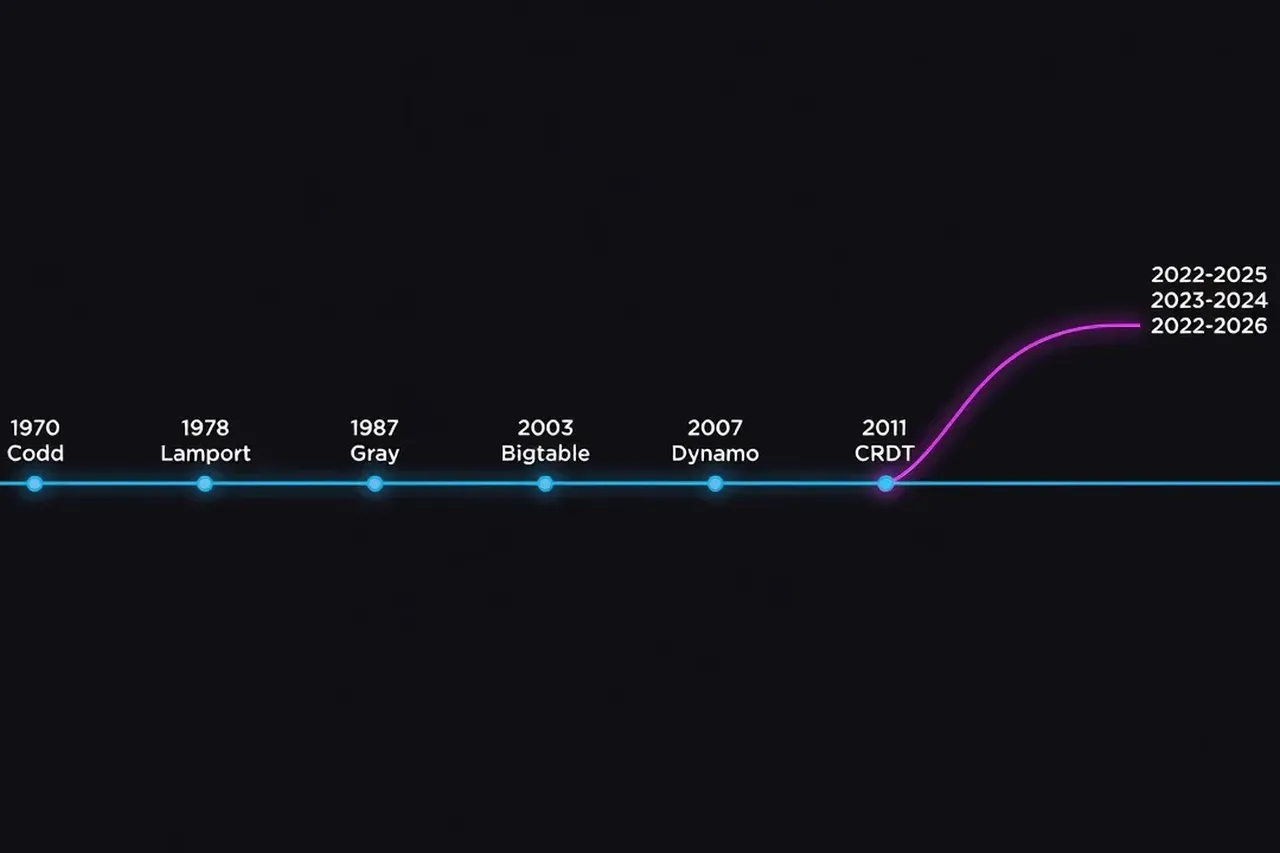
Navigating the archive of foundational papers on distributed databases is a journey through the evolution of ideas that have shaped the systems we use today. To make the most of this archive, we recommend starting with E.F. Codd's seminal paper on the relational model. This sets the context of where we came from and establishes the foundational ideas that NoSQL technologies would later build upon and diverge from. From there, move on to Leslie Lamport's work on distributed time and causality, which lays the groundwork for understanding how distributed systems maintain coherence. For a deeper dive into the fundamental constraints of distributed systems, the CAP theorem paper should be your next stop. Finally, explore Amazon's Dynamo paper to see how practical systems are constructed around the limitations described by the CAP theorem.
Reading these papers in historical order is crucial because each one responds to the challenges and limitations identified by its predecessors. The evolution of ideas is not just academic; it's a chronicle of problem-solving that continues to inform the design of modern distributed systems. In 2026, nearly every system you interact with is built upon principles discussed in these papers. Understanding their historical context enriches your ability to innovate and respond to contemporary challenges.
To grasp the nuances of distributed causality, start with Lamport's time clocks paper. This will provide a foundational understanding that resonates through the subsequent works on consensus and fault tolerance.
Classic Papers include Codd's 1970 relational model, Gray's 1981 transaction concept, and access path selection. These works form the bedrock of database theory, providing the structures and principles from which NoSQL technologies eventually diverged. While NoSQL represents a departure from these conventions, it also borrows fundamental ideas, demonstrating that innovation often stands on the shoulders of giants.
The Distributed Systems category encompasses Lamport's work on time clocks and virtual time, the Byzantine Generals problem addressing fault tolerance, virtual synchrony, and Paxos for consensus. These papers introduce the theoretical machinery that makes distributed databases feasible, detailing how systems can coordinate actions across multiple nodes without a central authority, maintaining reliability and consistency even in the face of network failures.
Modern NoSQL features transformative systems papers like Amazon Dynamo, Google BigTable, Google MapReduce, and Apache Cassandra. These works represent the practical application of distributed systems theory, paving the way for a decade of innovation in NoSQL platforms. They illustrate how organizations have harnessed distributed computing to build scalable, elastic, and resilient data infrastructures.
In the AI & Databases category, you'll find papers on CRDTs, the LSM-tree, and the BASE vs ACID consistency spectrum. These works are particularly relevant today as they underpin the architectures of vector databases and AI infrastructure. Concepts like conflict-free replicated data types and log-structured merge-trees are foundational to managing large-scale, distributed data in AI applications.
Case Studies such as Yahoo PNUTS and Designing and Deploying Internet-Scale Services offer a glimpse into real-world engineering challenges and solutions at scale, achieved before the advent of cloud platforms. These papers showcase the innovative engineering required to build and maintain large-scale, geo-distributed systems, providing valuable lessons in system design and operational excellence.
Tutorials include resources like Yahoo YCSB for benchmarking NoSQL systems and the nosqlsummer reading guide itself. These are designed to equip engineers with practical tools and frameworks to assess the performance and capabilities of NoSQL technologies, bridging the gap between theoretical understanding and practical application.
Choosing where to begin your exploration of these foundational papers depends on your current expertise and interests. For the junior engineer, starting with Amazon Dynamo is advisable. This paper is the most accessible among the landmark works and provides insights into system design choices that explain the behavior of technologies like Redis. Following this, the CAP theorem and eventually consistent models extend your understanding of system trade-offs in distributed environments.
If you're an academic or theory reader, the path through Codd's relational models, the transaction concept, and Paxos Made Simple offers a rich, formal exploration of database theory. This route unveils the rigorous logic underpinning distributed consensus and transactional integrity, highlighting how these elements have evolved over time.
For the AI/ML engineer, the journey starts with the LSM-tree paper, which elucidates the storage mechanics beneath every vector index. Follow this with CRDTs to understand multi-version concurrency control, and finish with a comprehensive vector databases article on our blog to see how these concepts power modern AI applications.
For engineers looking to deepen their understanding of network security fundamentals alongside systems design, jthinformatique.com offers practical introductions to cybersecurity basics.
Our annotations for each paper in the archive are structured into five sections to enhance your understanding and provide context. Each paper begins with "Why this paper matters," offering a concise rationale for its significance. "Key contributions" highlights the primary innovations and insights. "Impact on modern systems" connects historical ideas to contemporary applications, while "AI era" discusses the influence on current AI and ML infrastructures. Finally, "Further reading" suggests additional resources for deeper exploration.
The abstracts are preserved verbatim from an August 2013 capture by the Wayback Machine, providing an authentic glimpse into how participants of the original nosqlsummer engaged with these texts. This historical fidelity adds depth to your reading experience, connecting past interpretations with present-day insights.
The "AI era" section is particularly illuminating, as it reveals how foundational ideas continue to resonate in the design of LLMs, vector databases, and machine learning infrastructure. The LSM-tree paper is particularly relevant — RocksDB, LevelDB, and every major vector index storage layer descend from it. Recognizing these linkages underscores the enduring relevance of these foundational works, guiding you through the complexities of modern data systems.