On Designing and Deploying Internet-Scale Services

Why this paper matters
James Hamilton’s On Designing and Deploying Internet-Scale Services (2007) crystallized the operational wisdom that separated high-scale web systems from the rest. At a time when distributed systems research still fixated on algorithms and consistency trade-offs, Hamilton shifted focus to the human cost of running massive services. The paper didn’t just quantify the system-to-administrator ratio-it reframed scalability as a function of operational efficiency. Services like Windows Live Search weren’t scaling because of novel algorithms, but because their design minimized toil: predictable failure modes, automated recovery, and configuration that could be managed in bulk. This emphasis on operations-friendliness anticipated the cloud-native era, where infrastructure immutability and declarative APIs dominate. Even today, in 2026, the paper’s core insight-that software must be designed for the realities of its operational environment-remains foundational to platform engineering and SRE culture.
Hamilton’s framework emerged from firsthand experience at Microsoft, where he observed that the most resilient systems weren’t necessarily the most sophisticated, but the most boring. They followed strict patterns: homogeneous hardware, automated provisioning, and stateless services that could be restarted at will. This philosophy directly challenged the prevailing academic view that scalability was primarily a consistency problem. Instead, Hamilton argued, it was an operational problem-one where the cost of human intervention often dwarfed the cost of computation. His metrics, like mean time to recovery (MTTR) and system-to-administrator ratio, forced engineers to confront the hidden tax of complexity. In an era where cloud providers now embed SRE practices into their managed services, Hamilton’s insistence on designing for failure feels prophetic. It’s no coincidence that modern platforms like Kubernetes and Terraform are, at their core, implementations of Hamilton’s operational playbook.
The paper also introduced a mindset shift that persists in modern engineering: toil is the enemy. Hamilton demonstrated that the systems surviving at scale were not those with the most elegant distributed algorithms, but those where every repetitive task was automated, every failure mode was anticipated, and every configuration change was idempotent. This idea now underpins DevOps and platform engineering, where teams measure success not just in uptime or throughput, but in reducing cognitive load for operators. In a time when AI systems introduce new forms of unpredictability-prompt drift, embedding decay, non-deterministic outputs-Hamilton’s insistence on designing for entropy has become even more urgent. The AI era demands systems that can absorb chaos, not just resist it.
Key contributions
- Introduced the system-to-administrator ratio as a concrete metric for operational scalability, showing that high-scale services succeed not solely by technical brilliance but by minimizing human intervention.
- Formalized operations-friendliness as a first-class design goal: services must self-heal, expose clear health signals, and avoid states that require manual triage.
- Championed prefabricated failure recovery, where components are engineered to detect, isolate, and repair themselves with minimal external coordination.
- Advocated for standardized deployment units (e.g., homogeneous servers, immutable artifacts) to reduce configuration drift and enable fleet-level automation.
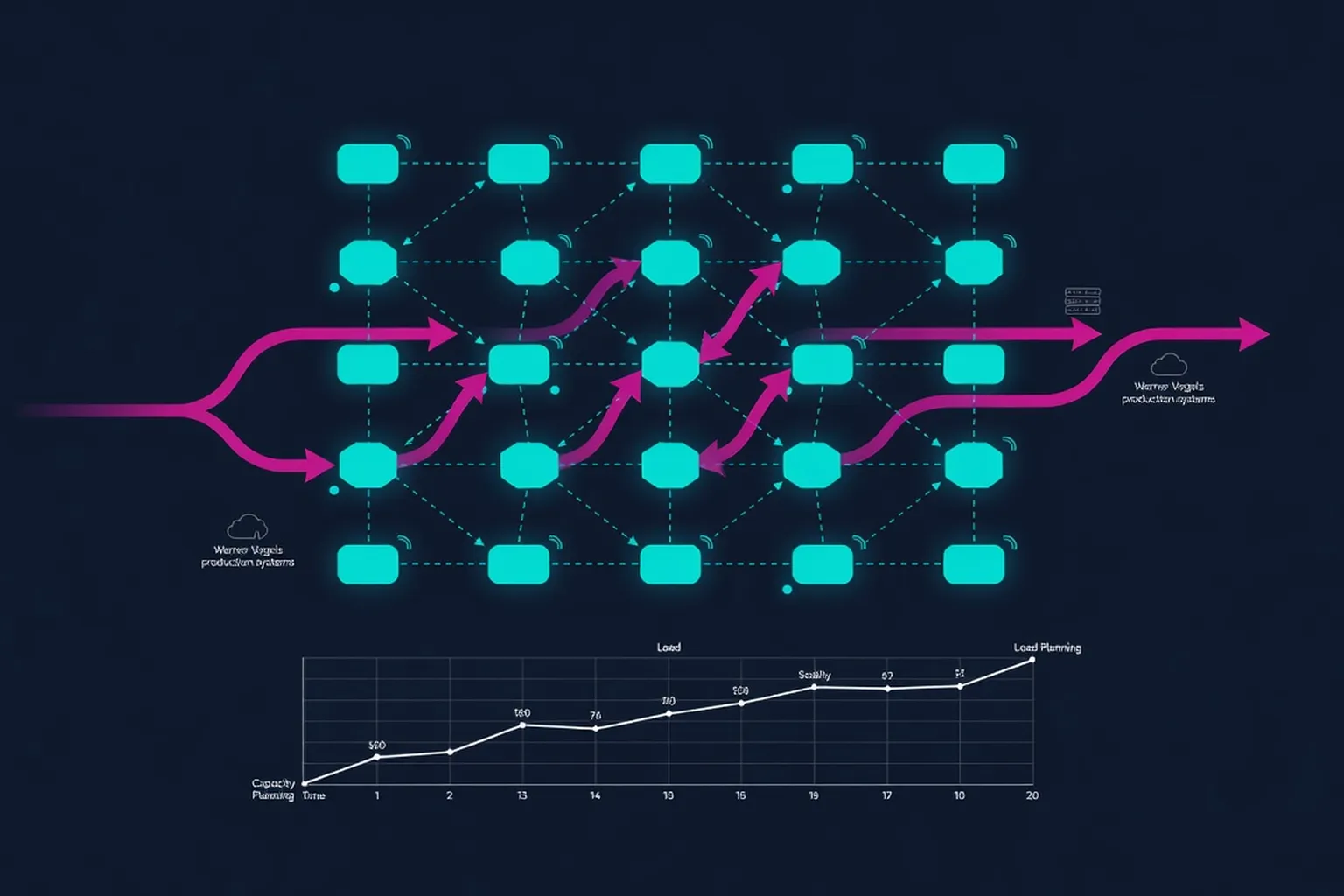
- Proposed data-driven capacity planning, where decisions are derived from telemetry rather than rules of thumb or vendor marketing.
- Documented patterns like canary deployments, rolling restarts, and configuration templating-now staples in continuous delivery pipelines.
- Highlighted the cost of human error in large-scale systems, framing operational complexity as a primary scalability bottleneck.
Impact on modern systems
Hamilton’s principles shaped the architecture of nearly every modern distributed database and platform built for scale. Consider CockroachDB (2014-present), which explicitly targets Hamilton’s operational pain points. Its design avoids cross-region transactions by default, preferring asynchronous replication with conflict resolution-a direct nod to Hamilton’s call for recovery-friendly state machines. CockroachDB’s use of changefeeds to propagate mutations across regions mirrors Hamilton’s emphasis on predictable failure isolation: when a node fails, the system doesn’t block; it continues serving stale reads while repairing. This aligns with the system-to-administrator ratio ethos: fewer human decisions during incidents.
Similarly, ScyllaDB (2015-present) inherits Hamilton’s focus on standardized deployment units. By replacing Java with C++ and sharding at the OS level, ScyllaDB achieves consistent latency at high throughput-making it easier to scale horizontally without increasing operator load. Its use of shared-nothing architecture and zero-copy networking reduces tail latency, a direct operational win: fewer noisy neighbors, fewer pages in on-call runbooks. ScyllaDB’s developers explicitly cite Hamilton’s operational scalability in their engineering blog, framing latency stability as a form of self-healing.
Even FoundationDB (2013-2022, now open source) reflects these ideas. Its layered architecture-where storage, coordination, and stateless layers are separated-was designed so that operators could scale or repair each tier independently. This modularity reduces blast radius during failures, a core Hamilton concept. When Apple open-sourced FoundationDB in 2023, they highlighted its automatic rebalancing and predictable failover as key operational virtues-again, rooted in Hamilton’s playbook.
Hamilton’s influence extends beyond databases. Kubernetes, the de facto orchestration platform, owes much to his idea of declarative state reconciliation. The Kubernetes control loop directly implements Hamilton’s prefabricated recovery: the system always converges to desired state, even when nodes fail. The rise of GitOps-using Git as the source of truth for infrastructure-is a direct extension of Hamilton’s call for immutable artifacts and reproducible deployments.
Hamilton also challenged the myth that consistency alone guarantees scalability. His critique of distributed transactions as a scalability inhibitor foreshadowed debates later crystallized in Life beyond Distributed Transactions: an Apostate’s Opinion. While BigTable (2006) supported strong consistency, Hamilton argued that many services could tolerate weaker models if the operational burden was lower. This tension-between consistency and operability-remains central in 2026, especially in systems like YugabyteDB, which offers PostgreSQL compatibility with distributed SQL, but defaults to asynchronous replication in multi-region setups to reduce latency and operator load. Another modern example is TiDB (2015-present), which decouples compute and storage to isolate failures and simplify scaling. By using the Raft consensus protocol for replication and TiKV for storage, TiDB ensures that failures in one component don’t cascade into global outages-a direct application of Hamilton’s blast radius reduction principle.
Cloud-native storage systems like Ceph (2006-present) also embody Hamilton’s principles. Ceph’s CRUSH algorithm distributes data uniformly across nodes, reducing hotspots and making recovery predictable. Its self-healing capabilities, where failed OSDs are automatically replaced and rebalanced, mirror Hamilton’s call for prefabricated failure recovery. Similarly, MinIO (2016-present), a distributed object store, leverages erasure coding and automatic healing to maintain durability without manual intervention. Both systems prove that Hamilton’s operational ethos scales beyond web services into storage infrastructure.
The influence of Hamilton’s work is also visible in modern data platforms. Snowflake (2014-present), for instance, abstracts away operational complexity by offering a fully managed cloud data warehouse. Its architecture-separating storage and compute, auto-scaling, and self-optimizing performance-directly reflects Hamilton’s principles. Snowflake’s ability to handle thousands of concurrent users without manual tuning is a testament to Hamilton’s vision of operations-friendliness. Similarly, Databricks (2013-present) employs automated cluster management and idempotent job scheduling, reducing the operational burden on data teams. These systems demonstrate that Hamilton’s ideas are not confined to web services but apply to any large-scale, user-facing platform.
AI era: how LLMs and vector databases relate to this paper
The AI era amplifies Hamilton’s operational thesis: systems must be designed for failure-but now, failure includes non-determinism, prompt drift, and embedding drift. Vector databases such as pgvector (PostgreSQL extension, 2021-present), Milvus (2019-present), and Qdrant (2020-present) embody Hamilton’s principles in a new domain. They must handle semantic drift (where embeddings change over time due to model updates), index corruption (from faulty quantization or pruning), and query planner instability (when LLM-generated queries vary in structure). These are not just technical bugs-they’re operational incidents.
Take RAG pipelines: a query is rewritten by an LLM, vectorized, and sent to a vector index. If the LLM hallucinates a schema change, the vector query may fail silently. This is a classic Hamilton failure mode-unpredictable input leading to silent degradation. Vector databases address this through schema versioning, idempotent index builds, and health checks on embedding freshness. Milvus’ dynamic schema and Qdrant’s local cache warm-up are operational responses to the same problem Hamilton faced: ensuring that a system remains stable even when its inputs are noisy. Systems like Weaviate (2019-present) go further by integrating semantic search with automatic reindexing, ensuring that embeddings stay aligned with the latest data without requiring manual intervention.
LLM inference systems also mirror Hamilton’s prefabricated recovery. Consider a system where multiple LLM instances serve prompts in parallel. If one instance crashes or returns malformed JSON, the system must fail fast, isolate, and retry with a backup model. This is exactly Hamilton’s recovery-friendly design, now applied to AI workloads. Tools like vLLM (2023-present) and SkyPilot (2022-present) implement batch inference with timeouts, graceful degradation, and resource isolation-all hallmarks of Hamilton’s operational philosophy. Even NVIDIA’s TensorRT-LLM (2023-present) incorporates automatic fallbacks and health probes to ensure that inference pipelines remain stable under load.
Vector databases also introduce a new metric: embedding freshness. In a RAG system, stale embeddings can degrade answer quality. Modern vector stores like Pinecone and Weaviate solve this with incremental index updates, change data capture (CDC), and vector expiration policies. These are not just performance optimizations-they’re operational guardrails, ensuring that the system doesn’t silently serve answers based on outdated knowledge. This aligns with Hamilton’s idea that systems must expose and act on their own health signals. For example, Pinecone’s serverless index automatically scales and rebalances, reducing operator toil while maintaining performance-a direct application of Hamilton’s data-driven capacity planning.
Even LLM-driven query planning reflects Hamilton’s call for automated decision-making. Systems like LangChain and DSPy (2023-present) use LLMs to generate SQL or NoSQL queries dynamically. When such a planner fails, the system must detect the failure (e.g., via query latency SLOs or result plausibility checks) and fall back to a safe path. This is autopilot for the AI era-Hamilton’s vision, now applied to non-deterministic logic. Frameworks like Haystack (2018-present) embed circuit breakers and retry policies specifically to handle LLM-induced failures, treating them as first-class operational concerns.
Finally, AI agent state stores (e.g., Hamiltonian state machines in agent frameworks) must support checkpointing, recovery from crashes, and deterministic replay-all principles Hamilton advocated. Without these, an agent that crashes mid-task cannot resume reliably. The rise of LangGraph (2024-present) and CrewAI (2024-present) underscores this: agent frameworks now embed operational guarantees like idempotent actions, retry policies, and state snapshotting. These are not AI innovations-they’re operational ones, repackaged for a new context. Even Microsoft’s AutoGen (2023-present) includes conversation state management with automatic recovery from failures, directly echoing Hamilton’s emphasis on self-healing.
In the AI era, Hamilton’s principles have found new life in systems designed to handle unpredictability at scale. Consider Redis Stack (2021-present), which combines a vector database with traditional caching. Its automatic failover and persistence guarantees ensure that even when embeddings or indexes degrade, the system remains available. Similarly, DuckDB’s recent foray into vector search (2023-present) emphasizes embedding management as an operational concern, not just a performance one. These systems prove that Hamilton’s ethos is not just enduring-it’s essential in a world where AI systems introduce new forms of entropy.
Further reading
- The Twelve-Factor App - A foundational methodology for building scalable, maintainable software-as-a-service apps, directly influenced by Hamilton’s operational principles.
- Google SRE Book - Chapter 6: Management - Covers system-to-administrator ratios, toil reduction, and automation, echoing Hamilton’s core themes.
- Distributed Systems Observability - Expands on Hamilton’s health-signal requirements with modern telemetry practices.
- CAP Theorem - A critical lens for understanding trade-offs in distributed systems, often referenced alongside Hamilton’s operational scalability insights.
- Eventually Consistent - Explores the consistency trade-offs Hamilton implicitly endorsed by prioritizing operational simplicity.
- On Designing and Deploying Internet-Scale Services - Original Paper (PDF)