A History of the Virtual Synchrony Replication Model
Why this paper matters
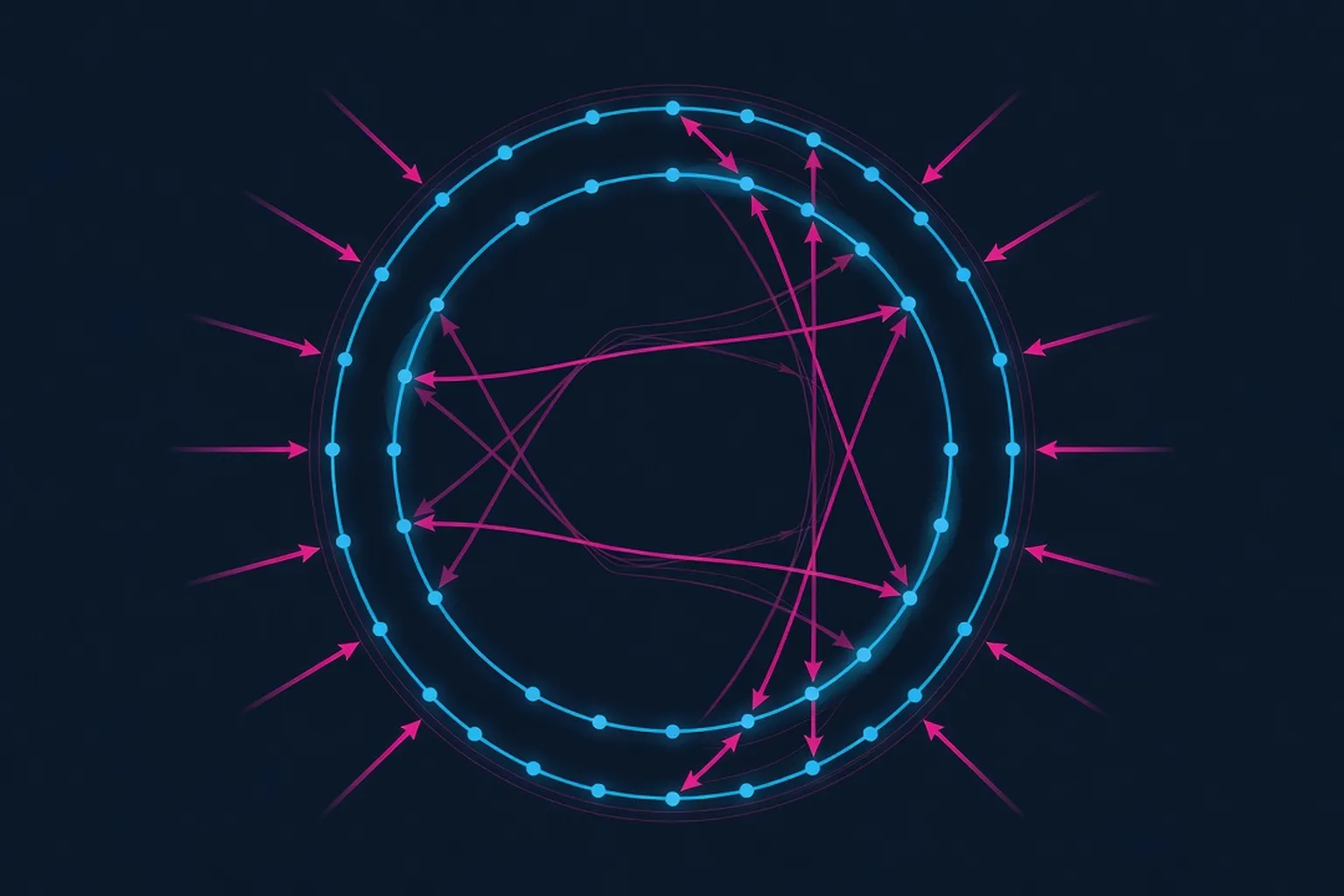
Ken Birman and Robbert Joseph’s 1987 paper A History of the Virtual Synchrony Replication Model codifies a foundational abstraction that decoupled correctness from timing in distributed systems, a shift as consequential as the move from RPC to message passing. At its core, virtual synchrony provides a formal model for reasoning about replicated state machines in asynchronous networks where crash failures and unbounded message delays are the norm. The model’s insistence on indistinguishability from a non-replicated single-node system introduced a rigorous yet implementable contract for developers: if a client cannot tell whether it is talking to one server or many, the replication is correct by construction. This was not merely theoretical; Birman and colleagues built Isis, a toolkit that operationalized virtual synchrony in production systems during the late 1980s and early 1990s, proving that strong consistency and fault tolerance could coexist with performance at scale.
By anchoring replication semantics in causal message delivery and group membership stability, virtual synchrony anticipated challenges that would dominate cloud-scale systems decades later: consistency under partition, reconfiguration without quorum loss, and transparent failure recovery. Its influence extends beyond academic rigor into the operational DNA of systems that now power trillions of transactions daily. In 2026, as vector databases and AI agents introduce new forms of stateful, distributed computation, the paper’s insistence on clear ordering and membership semantics remains a guiding light for engineers navigating the chaos of partial failure and unbounded concurrency. The model’s emphasis on process groups as first-class citizens-where membership changes are treated as state transitions rather than exceptions-has become the de facto way to reason about distributed systems, from consensus protocols to real-time collaboration tools.
Key contributions
- Formalized the virtual synchrony model: a specification for replicated state machines that guarantees behavior indistinguishable from a non-replicated reference system, even under crash failures and network asynchrony.
- Introduced the notion of view synchrony, where group membership changes are coordinated and delivered in a consistent order to all participants, enabling safe reconfiguration without split-brain.
- Defined causal message delivery as a first-class correctness property, ensuring that the effects of operations propagate in a manner consistent with real-time causality.
- Developed the Isis toolkit (1987-1993), the first widely adopted system to implement virtual synchrony, demonstrating viability through deployments in banking, telecom, and air traffic control.
- Established a separation of concerns between application-level semantics and replication protocol correctness, allowing developers to reason locally while the system guarantees global consistency.
Impact on modern systems
Virtual synchrony’s core ideas are visible in the design of modern database systems that prioritize strong consistency and operational safety at scale. FoundationDB (2013), for instance, adopts a layered architecture where the core transaction engine relies on a deterministic ordering layer-conceptually akin to a virtual synchrony view-in which all replicas agree on the sequence of state changes before applying them. This model enables FoundationDB to maintain ACID semantics across hundreds of nodes with microsecond-scale commit latency, a feat that traces directly to Birman and Joseph’s insistence on ordered, agreed-upon state transitions.
Similarly, YugabyteDB (2017), a PostgreSQL-compatible distributed SQL database, implements Raft-based consensus with a twist: it uses a synchronized replication stream that delivers transactions in a total order across all followers. While Raft differs in detail from virtual synchrony’s group membership model, both systems share the principle of view delivery-where configuration changes are broadcast and applied in lockstep. YugabyteDB’s ability to support globally consistent reads within 2-3ms at 100K+ TPS in multi-region deployments is a direct descendant of the virtual synchrony vision: a client cannot distinguish whether it is talking to a single node or a globally distributed cluster.
Even systems that prioritize availability over consistency borrow from virtual synchrony’s failure model. MongoDB’s replica sets (2010), for example, use a two-phase election and oplog truncation mechanism that ensures all secondaries process operations in the same order as the primary during normal operation. Although MongoDB relaxes isolation for scalability, its oplog synchronization leverages a form of causal ordering reminiscent of virtual synchrony’s message delivery guarantees. This allows clients to perform linearizable reads by targeting the primary or reading from secondaries with guaranteed staleness bounds-an operational compromise rooted in the same correctness ideals.
The influence extends beyond databases into infrastructure middleware. Apache Kafka (2011), in its early versions, used a simple leader-follower model, but as it scaled to support exactly-once semantics, it adopted a leader epoch and log end offset coordination mechanism that mirrors virtual synchrony’s view-based reconfiguration. Kafka’s ability to handle petabytes of daily throughput while maintaining idempotent producers and transactional writes is built on the same foundation: ensuring that all replicas agree on the sequence of events before they are considered committed. This is not coincidence; it is convergence.
Beyond specific systems, virtual synchrony’s legacy is visible in the formal frameworks now used to verify distributed protocols. Tools like TLA+ and Verdi rely on temporal logic to model group membership and message delivery order-concepts first articulated in Birman and Joseph’s work. The shift from ad-hoc replication to mathematically grounded correctness proofs in modern consensus systems (e.g., Raft, Paxos) traces its intellectual lineage to this paper’s insistence on rigor in the face of asynchrony.
The model’s impact is also evident in cloud-native systems like Kubernetes (2015), which uses a control plane to manage node membership and configuration changes in a manner akin to virtual synchrony’s group membership protocols. When a node joins or leaves a cluster, Kubernetes ensures that all components receive a consistent view of the cluster state before proceeding-a direct application of the view delivery principle. Similarly, etcd (2015), the distributed key-value store underlying Kubernetes, implements Raft consensus with a focus on leader stability and log consistency, both central tenets of virtual synchrony.
Another concrete example is Amazon Aurora (2014), which separates the database engine into a quorum-based storage layer and a stateless compute layer. Aurora’s storage nodes use a variant of Raft to agree on the order of log entries, ensuring that all database instances see a consistent view of the data. This design reduces the need for synchronous coordination in the compute layer, allowing Aurora to scale to millions of transactions per second while maintaining strong consistency. The quorum-based log replication in Aurora is conceptually similar to the agreed multicast in virtual synchrony, where all replicas deliver messages in the same order despite network partitions.
The Process Group Approach to Reliable Distributed Computing (1991) expands on virtual synchrony by formalizing process groups as first-class abstractions, directly influencing later systems like Spread Toolkit and JGroups. Together, these works form the backbone of modern fault-tolerant middleware.
AI era: how LLMs and vector databases relate to this paper
Virtual synchrony’s core tenets-causal ordering, deterministic state evolution, and group membership stability-are being rediscovered in the AI stack, where vector databases and LLM agents introduce new forms of distributed state that must remain consistent under concurrency and failure. Consider vector databases like Weaviate (2018) or Milvus (2019), which maintain large-scale vector indexes across distributed shards. These systems must ensure that insertions, deletions, and updates are applied in a causal order so that queries return results that reflect the true state of the index at query time-exactly the problem virtual synchrony solved for replicated logs.
Modern RAG (Retrieval-Augmented Generation) pipelines exacerbate this challenge. When an LLM generates a response, it relies on retrieved documents that must reflect a causally consistent snapshot of the knowledge base. If two agents concurrently update the same embedding vector, or if a reindexing job runs while a query is in flight, the system must prevent read skew. Vector databases like Pinecone (2019) and Qdrant (2020) address this by implementing distributed consensus on vector metadata and index versions, often using Raft or similar protocols. These protocols, in essence, implement a view-based consistency model: when a new index version is committed, it is delivered to all shards in a consistent order, mirroring virtual synchrony’s group membership and message delivery guarantees.
The rise of AI agents introduces another layer: long-lived, stateful conversations that span multiple tools, APIs, and data stores. Each agent’s state-its memory, context window, and tool invocations-must be replicated across nodes for fault tolerance and load balancing. Systems like LangChain’s state stores or custom agent frameworks built on Redis Streams or Kafka rely on deterministic replay and causal ordering to reconstruct agent state after failures. Redis Streams, for example, uses a consumer group model where each agent instance consumes messages in the same order, ensuring that tool calls and memory updates are applied consistently. This is virtual synchrony applied to AI: a group of replicas (agent instances) agree on the sequence of state-changing events, making recovery indistinguishable from a single, non-faulty node.
Even embeddings themselves are subject to virtual synchrony-like guarantees. When fine-tuning a model with new data, the embedding model and vector index must be updated in lockstep to avoid stale retrievals. Systems like Milvus implement compaction and sealing of segments to ensure that search queries see a consistent view of the index. This is analogous to a group view change: once a segment is sealed, all subsequent queries see the updated state, and ongoing queries complete against the previous version-preventing partial updates.
LLM inference latency is also impacted by these ideas. When serving LLMs in a distributed fashion (e.g., vLLM, TensorRT-LLM), the system must coordinate KV cache replication across GPUs to avoid duplication and ensure correctness. Although these systems do not yet implement virtual synchrony directly, the need for deterministic execution order in multi-GPU inference pipelines is a direct parallel. Future systems may adopt group-based replication for KV caches, where all replicas agree on the sequence of token generations before committing to the output stream-mirroring virtual synchrony’s message delivery semantics.
Finally, LLM-driven query planning-where an LLM rewrites SQL or NoSQL queries based on semantic intent-requires maintaining a causally consistent view of the database schema and data. If two LLM agents simultaneously plan queries that depend on overlapping tables, the system must ensure that the resulting queries reflect a consistent snapshot. Vector databases with embedded schema metadata (e.g., pgvector with metadata filtering) are beginning to address this by treating schema as a replicated state that must be delivered in order, much like the original Isis toolkit did for application state.
Vector databases like Chroma (2021) take this a step further by implementing transactional updates to their indexes. When a batch of documents is inserted, Chroma ensures that the update is atomic and visible to all subsequent queries-an explicit embrace of the virtual synchrony principle that state changes must be delivered in a consistent order. This is critical for applications like semantic search, where partial updates could lead to inconsistent results.
Timestamps in Message-Passing Systems That Preserve the Partial Ordering (1989) provides a complementary formalism for reasoning about causality in distributed systems, which is now being used to design vector commit protocols that avoid the pitfalls of Lamport timestamps in high-dimensional data. Similarly, the CAP Theorem (2000) frames the trade-offs that modern AI systems must navigate when balancing consistency, availability, and partition tolerance-trade-offs that virtual synchrony addresses by prioritizing correctness under asynchrony.
Further reading
- The Isis Toolkit Project (Cornell University)
- Virtual Synchrony in Practice: Lessons from the Isis Toolkit (ACM Queue, 2020)
- FoundationDB: A Distributed, Fault-Tolerant, Ordered Key-Value Store (2013)
- YugabyteDB: A PostgreSQL-Compatible Distributed SQL Database (2017)
- Weaviate: Vector Search with Contextualized Meaning (2020)
- Milvus: A Scalable Vector Database for AI Applications (2019)
- Redis Streams: A High-Performance Message Queue for AI Agents (2017)