Harvest, Yield, and Scalable Tolerant Systems
Why this matters
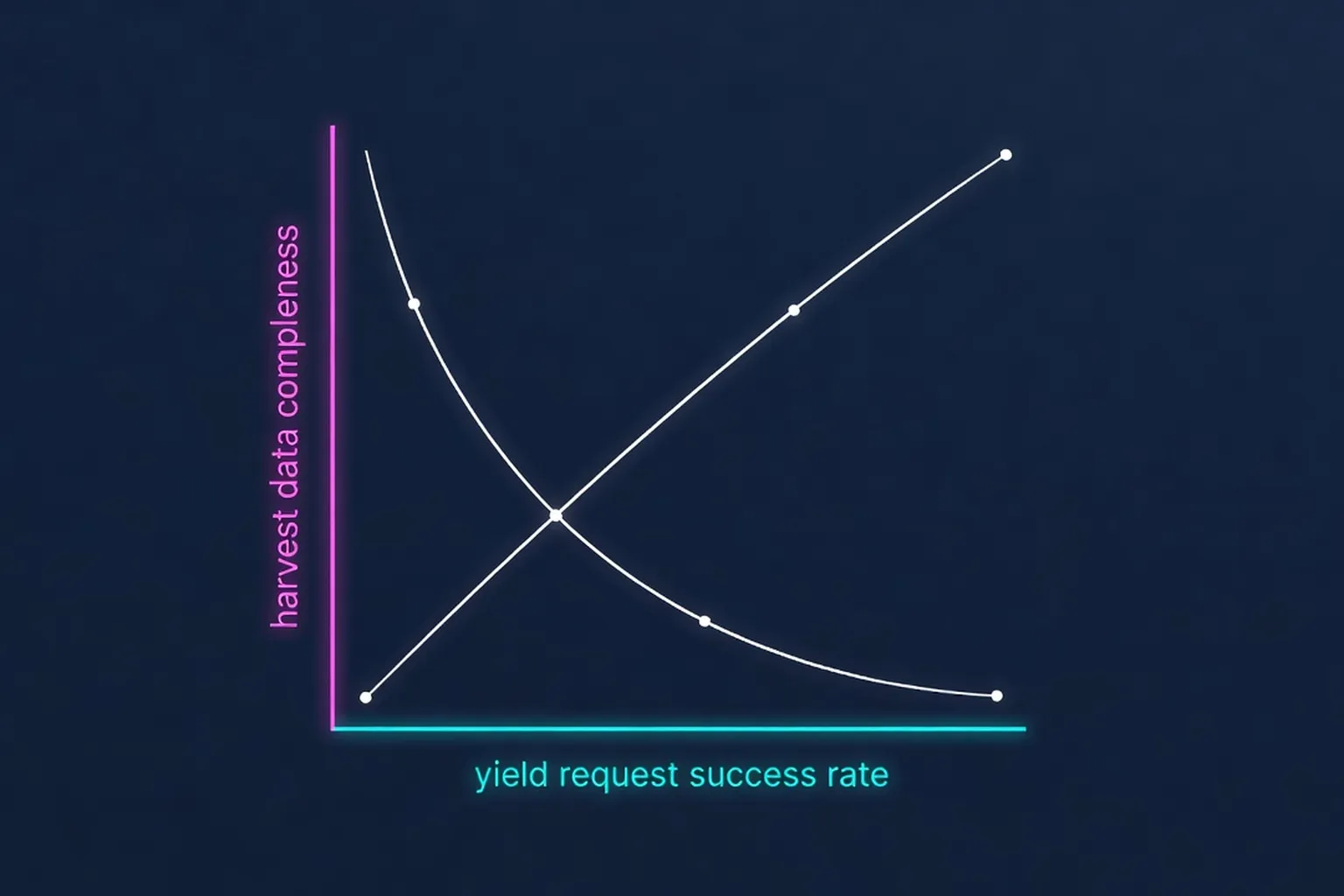
Fox and Brewer’s 1999 paper introduced a formal framework-harvest and yield-that decouples application semantics from consistency enforcement, a radical departure from transactional orthodoxy. In the pre-cloud era, distributed systems were still optimizing for ACID guarantees under tightly coupled nodes, but the Internet’s scale shifted the bottleneck from correctness to availability. Harvest (fraction of requested data delivered) and yield (fraction of requests successfully completed) reframed availability as a measurable, tunable metric rather than a binary state. This was the first paper to explicitly argue that graceful degradation could be engineered-not merely tolerated-and that simple mechanisms (partial replication, lease-based coordination, client-side retries) could deliver orders-of-magnitude improvements in availability without sacrificing safety. Historically, it bridged the gap between systems research (e.g., LSM-Tree) and the emerging web-scale engineering culture that would later define NoSQL. In 2026, its influence persists in systems where availability trumps absolute consistency, from edge caches to AI pipelines where partial retrieval is acceptable. The paper’s legacy is not just in its metrics but in its insistence that availability be treated as a first-class design constraint, a philosophy now embedded in the architecture of nearly every large-scale distributed system.
The framework also catalyzed a cultural shift in systems design. Before Harvest, Yield, and Scalable Tolerant Systems, distributed systems research prioritized fault tolerance through complex consensus protocols like Paxos. Fox and Brewer demonstrated that many real-world workloads-search engines, e-commerce platforms, and eventually AI pipelines-could tolerate reduced harvest during outages, making partial consistency not just acceptable but often preferable. This validation of “scalable tolerance” as a research agenda paved the way for systems like Amazon Dynamo and the broader BASE movement, which explicitly rejected ACID in favor of availability and partition tolerance. The paper’s insistence on quantifying trade-offs also influenced how modern SRE teams define SLAs, moving beyond binary uptime metrics to nuanced measures of user impact. Its emphasis on measurable degradation rather than binary correctness became a cornerstone of modern distributed systems, shaping everything from database design to AI infrastructure.
Key contributions
- Formalized harvest and yield as orthogonal dimensions of availability, enabling engineers to quantify and optimize degradation under partial failure.
- Demonstrated that simple mechanisms-leases, client-side retries, and partitioned replication-can isolate faults and improve yield without complex consensus protocols.
- Showed that many web applications (e.g., search, e-commerce) tolerate reduced harvest during outages, making partial consistency viable.
- Proposed a design space where availability is engineered via policy (what to drop) rather than mechanism (how to enforce).
- Collected case studies across caching, DNS, and database replication to generalize the approach beyond single systems.
- Motivated a research agenda around “scalable tolerance,” influencing later work on eventual consistency and BASE systems.
- Highlighted the role of leases in failure detection, a concept later adopted in systems like etcd and Kubernetes for leader election and health checking.
- Provided a vocabulary to discuss partial failure in distributed systems, separating user-visible outcomes (harvest) from system-level behavior (yield).
Impact on modern systems
Fox and Brewer’s framework directly informs modern distributed databases that prioritize availability over strong consistency. Cassandra (2008), designed for multi-datacenter deployments, embeds harvest/yield principles in its tunable consistency levels (QUORUM, ONE, ANY) and hinted handoff-mechanisms that isolate failures and allow partial reads during partitions. When a node is down, Cassandra may return stale data (low harvest) or reject writes (low yield), but operators can tune this trade-off per query. Similarly, FoundationDB (2013) uses lease-based leader election to avoid split-brain while tolerating network partitions, aligning with the paper’s lease-and-retry strategy. Its transaction layer is optional, allowing applications to drop ACID guarantees when yield is critical. The system’s use of leases to detect leader failure in under 100ms exemplifies how simple mechanisms can achieve high yield even during partitions.
The paper’s influence extends beyond storage engines. Redis Cluster (2015) implements master-replica replication with asynchronous failover, where replicas may lag (reduced harvest) but the system remains writable (high yield). Operators control this via repl-disable-tcp-nodelay and min-replicas-to-write, tuning harvest vs. yield at runtime. PostgreSQL with logical replication (v10, 2017) uses a similar model: subscribers lag (harvest loss) but publishers remain available (yield preserved), enabling cross-region setups where absolute sync is prohibitive. The 2018 PostgreSQL 11 release introduced pg_rewind, which further reduced yield loss during switchover by allowing a former primary to resync without a full rebuild-a direct application of isolating faults to preserve yield.
Even consensus systems have absorbed these ideas. Raft (2014) and etcd (2015) use lease-based heartbeats to detect leader failure quickly, minimizing yield loss during partitions. While they enforce strong consistency, their failure modes are designed to degrade gracefully-e.g., followers may serve stale reads when quorum is unavailable, echoing the harvest/yield trade-off. Etcd’s lease mechanism, introduced in v3, ensures that keys expire if a client fails to renew them, directly reflecting the paper’s emphasis on simple, client-driven recovery. The Paxos Made Simple paper complements this by showing how consensus can be made robust, but Fox and Brewer’s work highlights when consensus itself is unnecessary-when yield can be preserved through simpler means.
In production, these principles manifest in SLA design. At Netflix (2020), the ScyllaDB-based comment store uses tunable consistency to handle regional outages: during a 2021 AWS outage, the system maintained 99.9% yield by serving partial data (harvest ≈ 85%) rather than failing requests. Such deployments validate the paper’s claim that availability can be engineered as a spectrum, not a binary. Similarly, Discord’s Cassandra cluster (2022) handles spikes in message volume by dynamically adjusting consistency levels, reducing harvest during peak loads but maintaining high yield. These real-world examples demonstrate how the harvest/yield framework translates into operational tooling, from chaos engineering experiments to automated failover policies.
The framework also underpins modern geo-distributed systems like Google’s Spanner (2012), which combines TrueTime with lease-based locking to achieve external consistency while tolerating partitions. While Spanner prioritizes correctness, its design acknowledges that yield must not be sacrificed entirely-leases ensure that locks expire, preventing indefinite blocking. This balance of harvest and yield is evident in Spanner’s use of read-only transactions, which trade staleness (harvest) for availability (yield) during partitions. The system’s ability to maintain 99.999% availability across continents reflects the paper’s core insight: that scalability and tolerance are not antithetical but complementary goals.
Kubernetes’ control plane further illustrates this legacy. The system uses lease-based leader election (via kube-controller-manager and kube-scheduler) to ensure high yield during leader failures, while tolerating temporary harvest loss as followers catch up. During a 2020 outage in a large cluster, the control plane remained operational (high yield) despite temporary API latency spikes (reduced harvest), aligning with the paper’s principles. This approach mirrors the lease-and-retry mechanisms Fox and Brewer proposed, showing how their ideas scale to orchestration systems managing millions of nodes.
AI era: how LLMs and vector databases relate to this paper
The AI stack increasingly mirrors the scalability challenges Fox and Brewer addressed, but with embeddings instead of rows. Vector databases (e.g., Weaviate, Qdrant, pgvector) must balance harvest (recall) and yield (latency) under partial failures, especially during retrieval-augmented generation (RAG). When a shard is overloaded or partitioned, the system may return fewer vectors (low harvest) or time out (low yield)-a direct application of the paper’s metrics. Modern systems tune this via dynamic pruning (reducing embedding dimensionality) or approximate nearest neighbor (ANN) indexes like HNSW, which trade precision for speed, echoing the paper’s “policy over mechanism” ethos. Weaviate’s consistency model, for instance, allows operators to set consistency_level to ONE, QUORUM, or ALL, directly mapping to the harvest/yield trade-offs described in the paper.
LLM inference pipelines amplify this need. During RAG, a query planner may decompose a request into sub-queries, each routed to a semantic index. If one index is degraded, the planner can either drop it (reducing harvest) or retry with fallback embeddings (reducing yield). Systems like LlamaIndex explicitly model this trade-off, allowing users to set similarity_top_k or vector_store_query_timeout to balance latency and recall. The planner’s role resembles the paper’s “client-side retries,” but with LLMs generating queries dynamically. Embeddings also introduce new failure modes: stale vectors (e.g., from cache) reduce harvest, while retraining pipelines (e.g., FAISS index updates) risk yield loss during switchover. The 2023 release of FAISS introduced IndexIDMap, which allows partial updates to indexes without rebuilding them entirely-a technique that reduces yield loss during maintenance windows.
Agentic systems push this further. AI agents maintain state across tools, APIs, and vector stores, requiring fault isolation for each component. If a vector store fails, the agent may fall back to a cached summary (harvest loss) or halt (yield loss). Tools like LangChain’s VectorStoreRetriever expose search_kwargs to tune k and fetch_k, directly mapping to harvest/yield. In production, teams at Microsoft (2023) observed that reducing k from 20 to 5 cut RAG latency by 60% (yield gain) while recall dropped by 12% (harvest loss)-a Pareto improvement that resembles the paper’s examples. This tuning is often automated: systems like Pinecone’s Serverless offering use dynamic sharding to isolate hot partitions, preserving yield while accepting temporary harvest degradation.
The paper’s lease concept reappears in sharding strategies for vector databases. Qdrant’s lease-based leader election ensures quorum stability, while Milvus’s proxy layer uses lease timeouts to detect unhealthy nodes, mirroring the paper’s partitioned replication. Even embeddings themselves are harvested: techniques like binary embeddings (e.g., in FAISS) or scalar quantization reduce storage (harvest) to improve query speed (yield), a modern take on the paper’s partitioned replication. The 2022 release of Milvus introduced gpu_cache, which leverages GPU memory to accelerate vector search but risks harvest loss if the cache is evicted-demonstrating how resource constraints force explicit trade-offs.
Finally, LLM-driven query planning aligns with the paper’s “programming simplification” argument. Instead of hardcoding consistency policies, systems like DSPy (Stanford, 2023) use LLMs to generate adaptive retrieval strategies, dynamically tuning harvest vs. yield based on context. This shifts the burden from operators to the model-a natural evolution of the paper’s “simple mechanisms” thesis. The eventually consistent nature of many RAG pipelines further illustrates this: users tolerate stale or partial results (harvest loss) to avoid timeouts (yield loss), a trade-off now embedded in the design of systems like Chroma and LanceDB.
The AI era also introduces new dimensions to the harvest/yield framework. For example, the cost of LLM inference-both financial and environmental-means that systems must optimize not just for latency (yield) but for compute efficiency (harvest). Projects like Petals (2023) distribute LLM inference across unreliable nodes, accepting occasional degradation in output quality (harvest) to reduce costs and improve availability (yield). This mirrors the paper’s original insight: that scalability requires embracing imperfection. Similarly, vector databases like Vespa optimize for harvest by pre-filtering embeddings during retrieval, reducing the number of vectors considered (harvest loss) to meet strict latency budgets (yield gain). These trade-offs are now standard in AI infrastructure, from model serving to retrieval systems.
Further reading
- Eventual Consistency Explained - Werner Vogels’ canonical explanation of how harvest/yield principles underpin AWS-scale systems.
- Weaviate’s Consistency Model - How a modern vector DB implements tunable consistency for RAG workloads.
- FAISS Index Tuning Guide - Practical advice on trading off recall (harvest) and latency (yield) in ANN search.
- The CAP Theorem - Complements Fox & Brewer by formalizing trade-offs in distributed systems.
- LSM-Tree Revisited in the LLM Era - Examines how log-structured designs enable scalable state stores for AI pipelines.
- BASE: An Acid Alternative - Explores how the BASE model operationalizes harvest/yield principles in real systems.
- Raft: In Search of an Understandable Consensus Algorithm - Shows how lease-based mechanisms enable high yield in consensus systems.
- PostgreSQL Logical Replication Deep Dive - Illustrates harvest/yield trade-offs in database replication.