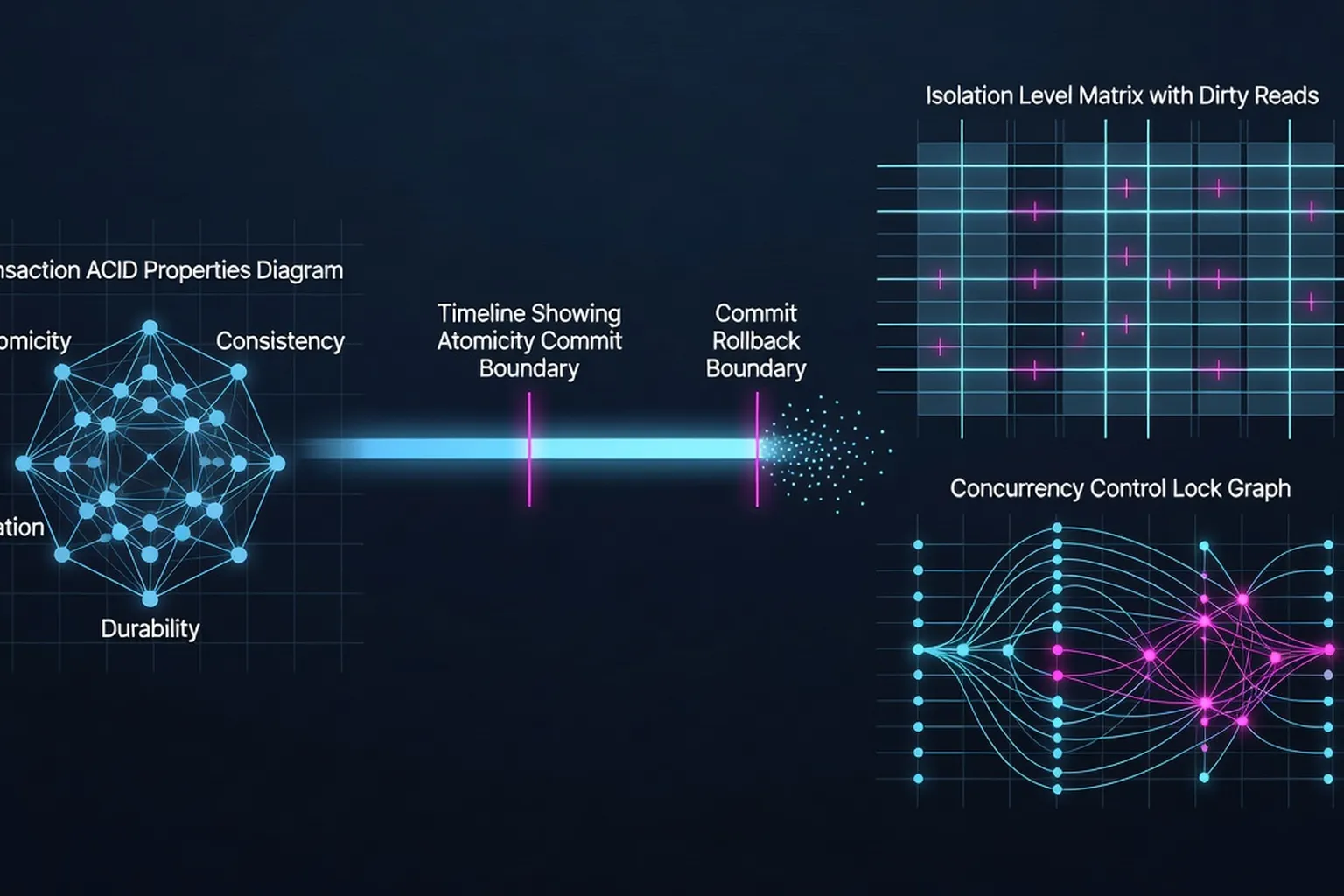
The Transaction Concept: Virtues and Limitations

Why this paper matters
Jim Gray’s 1981 paper The Transaction Concept: Virtues and Limitations crystallized the transaction abstraction into a rigorous, system-level primitive that became the bedrock of distributed data management. Written during the twilight of pre-relational CODASYL systems and the ascent of SQL, Gray codified what had been implicit in earlier work-atomicity, consistency, isolation, durability (ACID)-into a formal contract between applications and storage engines. The paper’s primary historical contribution was to elevate transactions from a correctness notion to a first-class architectural construct, enabling a generation of systems to reason about failure, concurrency, and correctness under a single umbrella. Without this formulation, modern distributed databases such as Google Spanner or CockroachDB would lack a coherent model for serializable multi-region writes or automated recovery after datacenter failure.
At the time of its publication, the transaction concept was not yet universally accepted as a system primitive. Gray’s work provided the missing link between abstract database theory-serializability, two-phase locking, and recovery protocols-and practical engineering. By framing transactions as a system-level contract, he made it possible for database architects to design storage engines, replication protocols, and concurrency control mechanisms that could be independently reasoned about and composed. This shift was critical in enabling the horizontal scalability of modern systems, where consistency guarantees must hold across thousands of nodes and multiple administrative domains.
By 2026, the transaction concept remains the primary lens through which we reason about correctness in globally distributed, multi-tenant systems running at planetary scale. Systems like FoundationDB (used by Apple at exabyte scale) and YugabyteDB (PostgreSQL-compatible with Raft-based replication) ship with transactional guarantees that directly descend from Gray’s 1981 definitions. The paper’s insistence on atomicity and durability underpins today’s consensus protocols, while its discussion of long-lived transactions anticipates modern sagas and workflow engines used in FinTech and supply-chain systems. In essence, Gray’s work provided the theoretical scaffolding that allowed distributed databases to scale horizontally without sacrificing correctness-a prerequisite for the AI era’s data-intensive workloads.
The influence of this paper extends beyond traditional databases. It shaped the design of distributed consensus systems such as etcd (2013), which uses Raft to implement durable, atomic state transitions across clusters. Even in blockchain systems, where immutability is a core feature, the durability and atomicity properties Gray defined are echoed in the design of ledger entries that must survive node failures and network partitions. The transaction concept, in this sense, has become a universal abstraction for reasoning about state changes in unreliable, distributed environments.
Key contributions
- Defined the ACID transaction model-atomicity, consistency, isolation, durability-mapping abstract correctness to concrete system guarantees.
- Formalized durability as a first-class property: once committed, data survives failures, grounding replication and recovery strategies.
- Introduced isolation levels as a spectrum from read uncommitted to serializable, enabling systems to trade latency for correctness.
- Proposed transaction composition via nested transactions and subtransactions, laying groundwork for sagas and workflows.
- Highlighted the challenge of long-running transactions (days to months), foreshadowing modern workflow systems and compensating transaction patterns.
- Positioned transactions as a general structuring mechanism beyond databases, influencing programming language and distributed systems design.
- Established a formal model for recoverability and failure atomicity, which later influenced the design of crash recovery protocols in systems like LSM trees.
Impact on modern systems
Gray’s transaction model is embedded in the DNA of every major distributed database shipping today. Google Spanner, introduced in 2012 and now running across hundreds of datacenters, implements externally consistent, globally serializable transactions using TrueTime and Paxos-an architecture that would be unthinkable without a clear definition of serializability and durability. Spanner’s externally consistent reads and snapshot isolation directly descend from Gray’s isolation taxonomy and durability guarantees. Similarly, CockroachDB (2014), a PostgreSQL-compatible database designed for multi-cloud resilience, uses Raft for replication and serializable snapshots to honor the isolation and atomicity properties Gray articulated.
The durability guarantee has shaped modern replication stacks. FoundationDB, the distributed key-value store behind Apple’s cloud services, achieves sub-millisecond commit latency with strict serializability by combining Raft-based replication with deterministic locking-an evolution of Gray’s durability requirement baked into every write path. Even document stores like MongoDB (introduced 2009) adopted multi-document ACID transactions in 2018, aligning their public API with Gray’s decades-old semantics to meet enterprise compliance and audit demands. This shift was not merely cosmetic; it required fundamental changes to MongoDB’s storage engine, including the introduction of a distributed transaction coordinator and a two-phase commit protocol across shards.
Isolation levels from this paper remain the dominant way to describe concurrency behavior. PostgreSQL (1996, with major modern transaction features added in the 2010s) exposes READ COMMITTED, REPEATABLE READ, and SERIALIZABLE, mirroring Gray’s spectrum. These levels directly inform lock manager design, MVCC implementation, and even query planner decisions. The planner’s cost model for access path selection often includes a hidden transaction-awareness parameter-whether to prefer a lock-free snapshot scan (READ COMMITTED) or a heavier serializable scan to avoid anomalies see Access Path Selection in an RDBMS, 1979. Modern systems like CockroachDB extend these levels with AS OF SYSTEM TIME queries, enabling historical snapshots that align with Gray’s durability vision.
Handling long-running transactions has evolved into workflow engines such as Temporal (2019), which implement Gray’s subtransaction ideas as compensating actions and sagas. In financial clearing systems, a multi-day settlement process is modeled as a saga: each step is a short ACID transaction, and failures trigger compensations-an architectural pattern Gray explicitly called for in 1981. This pattern is now widespread in microservices architectures, where distributed sagas coordinate actions across services while preserving atomicity. Systems like Uber’s Cadence and Netflix’s Conductor operationalize these ideas at scale, managing thousands of concurrent workflows with transactional semantics.
Even consensus protocols draw on the paper’s insights. Raft (2014), now ubiquitous in etcd, CockroachDB, and TiKV, guarantees that once a log entry is committed, it will never be lost-echoing durability. The paper’s emphasis on atomicity underpins Raft’s log replication invariant: either a command is applied to all replicas or none. Without this, modern distributed systems would lack the foundational correctness that enables safe multi-region deployments. Raft’s leader election and log replication mechanisms implicitly rely on atomic state transitions, a concept Gray formalized decades earlier.
Another modern system deeply influenced by Gray’s work is Amazon DynamoDB (2012), which introduced transactional capabilities in 2018. DynamoDB Transactions provide ACID guarantees across multiple items and tables, a feature that required rearchitecting the underlying storage layer to support atomic writes and consistent reads. The system uses a combination of optimistic concurrency control and a two-phase commit protocol to ensure that transactions either fully commit or fully abort, even in the presence of network partitions. This design directly reflects the durability and atomicity principles outlined in Gray’s paper. Similarly, Apache Cassandra (2008) added lightweight transactions in 2012 using Paxos, demonstrating how a system originally designed for eventual consistency could adopt stricter guarantees when the use case demanded them see CAP Theorem and the limits of distributed consistency.
AI era: how LLMs and vector databases relate to this paper
The rise of vector databases (Pinecone, Weaviate, Qdrant, pgvector) introduces a new correctness challenge: semantic consistency across embeddings, not just syntactic SQL constraints. Gray’s durability and atomicity now apply to vector embeddings as well-once a user inserts a document and its embedding is indexed, the system must guarantee the vector remains consistent with the document even under failures. Pinecone’s managed service replicates P99 commit latencies below 50 ms across three regions, a durability contract that mirrors Gray’s original requirement but applied to high-dimensional vectors.
Retrieval-Augmented Generation (RAG) pipelines depend on atomic, consistent reads from vector stores during inference. If a vector is updated mid-query, the LLM may receive inconsistent context, producing hallucinations or outdated answers. Modern vector databases implement serializable snapshots or read-your-writes isolation to prevent such anomalies. Weaviate’s transactional batch API and Qdrant’s ACID-compliant collections operationalize Gray’s isolation model in the AI stack, ensuring that embeddings and metadata stay coherent during concurrent ingestion and retrieval.
Long-running AI workflows-agent state stores, multi-step tool calls, and LLM-driven query planning-resemble Gray’s long-lived transactions. An agent that queries a database, calls an external API, and updates a vector store must either complete all steps or roll back cleanly. Systems like LangChain’s “workflows” and Microsoft’s Semantic Kernel implement saga patterns: each step is a short ACID operation, and failures trigger compensations. This composition model is a direct realization of the subtransaction ideas Gray proposed in 1981. In production systems, such workflows can span minutes or hours, requiring durable state management and compensating logic-exactly the challenges Gray anticipated.
Embedding generation itself often runs as a transactional pipeline: raw text is parsed, tokenized, and vectorized atomically with metadata. If any step fails, the entire embedding and its references must be rolled back to avoid dangling vectors. pgvector (2021) leverages PostgreSQL’s MVCC to provide snapshot isolation for embedding updates, aligning vector operations with traditional ACID semantics. This ensures that even in the presence of concurrent writes, queries return a consistent view of the index, preventing anomalies that could mislead downstream LLM inference.
LLM inference latency benefits from snapshot isolation too. A RAG system can serve a consistent snapshot of the vector index during a user session, eliminating staleness without locking writes. This is a practical application of Gray’s isolation levels in high-throughput AI systems. For example, in a customer support chatbot, a snapshot isolation level ensures that a user’s query sees a consistent version of the knowledge base, even as new documents are being indexed. This prevents the LLM from receiving conflicting information mid-conversation, a scenario that could degrade user experience.
Semantic indexes-vector embeddings used as secondary indexes-require durability guarantees as strong as B-tree indexes. Milvus and Chroma both support write-ahead logging and replication to ensure that an embedding survives a node failure. Without Gray’s durability principle, semantic search could not be trusted in production AI pipelines. Consider a recommendation system that relies on vector similarity search: if embeddings are lost due to a crash, the model’s accuracy could degrade until the index is rebuilt. Durability ensures that such critical state persists, aligning with Gray’s original vision of committed data surviving failures.
The integration of transactions into AI pipelines is not limited to vector databases. Even LLM serving systems like vLLM (2023) and TensorRT-LLM (2024) incorporate transaction-like mechanisms for managing model weights and KV caches. While these systems do not expose ACID interfaces to users, their internal state management often relies on atomic updates and crash recovery protocols that echo Gray’s principles. For instance, vLLM’s PagedAttention engine must ensure that updates to attention caches are atomic and durable, preventing corruption that could lead to incorrect token predictions. Similarly, systems like Ray Serve (2020) use transactional state management to coordinate actor-based workflows, demonstrating how Gray’s concepts extend beyond traditional databases.
Further reading
- ACM Queue: The Five-Minute Rule for Trading Memory for Disk Accesses and The Five-Millisecond Rule for Trading Memory for CPU Registers - external
- MIT 6.824 Distributed Systems Lecture Notes on Transactions and Serializability - external
- The 1995 SQL Reunion: People, Projects, and Politics, 1995
- A History of the Virtual Synchrony Replication Model, 1987
- CAP Theorem and the limits of distributed consistency
- Eventually Consistent: Reaping the Benefits of Eventual Consistency Without Sacrificing Application Semantics
- Amazon DynamoDB Transactions: Design and Implementation - external