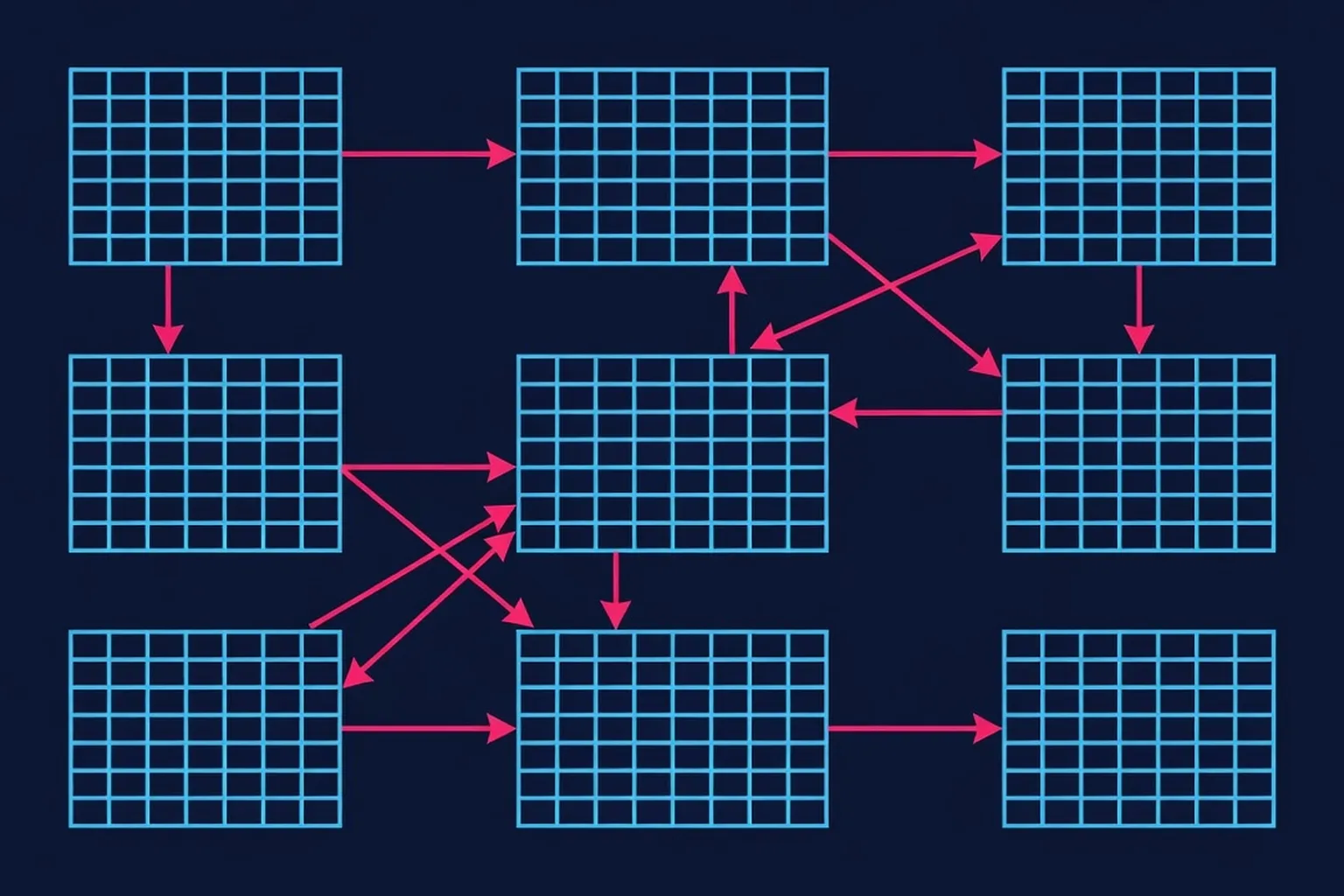
Codd's Relational Model
Why this paper matters
Codd’s 1970 paper codified the relational model of data, fundamentally decoupling logical data independence from physical storage-a principle that underpins every mainstream database system in 2026. Before Codd, database systems were tightly coupled to hierarchical or network structures, forcing programmers to navigate pointer chains and access paths embedded in application logic. Codd’s separation of logical relations from physical representation enabled users to query data using declarative languages (later SQL) without knowledge of storage layouts, indexing strategies, or network topologies. This abstraction shielded applications from changes in data representation, allowing schema evolution without rewriting queries or business logic. It also enabled a new class of tools-query optimizers, view managers, and constraint enforcers-that could evolve independently of application code, a feat impossible under pre-relational systems.
The paper introduced a mathematically rigorous foundation-relational algebra and tuple calculus-turning database design from ad-hoc engineering into a formal discipline. Its influence extends beyond SQL: the model’s normalization theory prevents update anomalies, its view mechanism enables controlled access, and its transaction model (later expanded in Codd’s 1981 paper) ensures consistency. Even systems rejecting SQL-like Cassandra and DynamoDB-rely on relational principles such as keys, partitions, and atomic operations. In 2026, this abstraction enables cloud-native databases to scale across continents while preserving application correctness, proving that Codd’s core insight remains the bedrock of distributed data systems. The model’s enduring relevance is evident in how modern systems like Kubernetes-native databases (e.g., YugabyteDB on EKS) still enforce relational integrity at scale, decades after its inception.
Codd’s work also laid the groundwork for metadata-driven architectures. Systems such as Apache Iceberg and Delta Lake use relational-style schemas over data lakes, treating files as tuples in a logical table. This allows users to query petabyte-scale datasets without managing file paths or block locations-exactly the logical independence Codd envisioned. Even in the AI era, this principle persists: vector databases expose semantic tables where embeddings are attributes, and queries are written in a declarative dialect, not as imperative traversals of HNSW graphs. The rise of AI-native databases like SingleStore and Rockset further demonstrates this continuity, offering SQL over vectorized data with millisecond response times.
Key contributions
- Formalized the relational model using set theory: relations as tables, attributes as columns, tuples as rows, with constraints (keys, foreign keys) defined declaratively.
- Introduced relational algebra as a query language foundation, enabling compositional reasoning about data transformations.
- Defined three levels of data abstraction: external (user views), conceptual (logical schema), and internal (physical storage), enabling logical data independence.
- Specified integrity constraints (entity integrity, referential integrity) to preserve semantic correctness across updates.
- Proposed a data sublanguage based on tuple calculus, later inspiring SQL and QBE.
- Demonstrated how normalization reduces redundancy and update anomalies, forming the basis for schema design best practices.
Impact on modern systems
Codd’s separation of logical and physical layers is visible in every modern distributed database. PostgreSQL (v15, 2022) implements logical replication and materialized views-direct descendants of external-conceptual-internal separation-allowing queries to run against up-to-date views without rewriting application code. Its query planner examines thousands of possible execution paths before choosing one, a process rooted in Codd’s insistence that users need not know how data is accessed. CockroachDB (v22.2, 2023) applies the same principle at scale: it supports SQL over geographically distributed data while hiding sharding, replication, and failure recovery from users, exactly as Codd envisioned when he wrote that “users at terminals… remain unaffected when internal representation changes.”
Cassandra (v4.1, 2022) and DynamoDB (2023) internalize the relational model’s key concepts-partition keys, clustering columns, and atomic writes-even though they depart from SQL syntax. Cassandra’s data model is a multi-dimensional map indexed by composite keys, a direct reinterpretation of relational keys with physical access paths abstracted. DynamoDB’s single-table design uses item attributes as primary keys and secondary indexes, mirroring Codd’s idea of access-path independence: applications query by attribute values, not storage pointers. Behind the scenes, DynamoDB partitions data using consistent hashing and replicates it across availability zones using a protocol inspired by Paxos-a modern twist on Codd’s transaction isolation, ensuring atomicity despite distribution.
Codd’s normalization theory underpins schema design across modern systems. Even in document stores like MongoDB (v6.0, 2023), developers are encouraged to normalize embedded arrays to avoid update anomalies-echoing Codd’s First Normal Form. Spanner (2023) combines Codd’s relational model with distributed consensus, using SQL over globally consistent data, proving that logical independence can coexist with horizontal scale. CockroachDB’s use of Raft consensus for ACID transactions across regions is a modern implementation of the transaction concept, which Codd seeded in 1970 and formalized in 1981. This enables applications to update relational data across continents with strong consistency, a direct fulfillment of Codd’s original goals.
The rise of cloud-native databases like TiDB (v6.5, 2023) and YugabyteDB (v2.18, 2023) further demonstrates Codd’s legacy. They offer PostgreSQL-compatible SQL interfaces over shared-nothing architectures, enabling users to migrate legacy applications without rewriting queries-exactly the logical data independence Codd demanded. These systems route queries to replicas, rebalance partitions, and recover from failures transparently, keeping internal changes invisible to users, as Codd insisted 50 years ago. TiDB’s integration with Kafka and Flink shows how relational logic can drive real-time pipelines, while YugabyteDB’s use of Raft for replication ensures durability across failure domains.
Modern analytical systems like Apache Druid and ClickHouse also reflect Codd’s influence. They allow users to define rollup tables and materialized views over raw events, enabling fast aggregations without rewriting queries. The LSM-tree storage engine, used in systems like ScyllaDB and Cassandra, optimizes write-heavy workloads by treating memtables and SSTables as logical constructs, not physical concerns. This abstraction lets applications scale writes without sacrificing query performance, a balance Codd’s model anticipated decades earlier.
Google Bigtable (2006), while not a relational system, embodies Codd’s principles in its design. It exposes a sparse, distributed multi-dimensional sorted map via a simple API, allowing users to query by row key, column family, and timestamp without knowledge of underlying storage mechanics. This mirrors Codd’s insistence on logical independence, where users interact with data through well-defined schemas rather than physical storage details. Similarly, Amazon Aurora (2014) decouples compute and storage, enabling elastic scaling while preserving SQL compatibility-a direct application of Codd’s abstraction layers. Aurora’s storage layer replicates data synchronously across three availability zones, ensuring durability without exposing replication details to applications.
The 1979 paper Access Path Selection in an RDBMS details how modern query optimizers (like PostgreSQL’s planner) implement Codd’s vision by choosing execution paths without user intervention. Without Codd’s abstraction, such optimizers would be impossible. Moreover, systems like Snowflake (2023) take Codd’s principles further by separating storage, compute, and cloud services entirely, allowing users to scale each layer independently while maintaining a unified SQL interface. This extreme decoupling demonstrates how deeply Codd’s ideas have permeated modern architectures.
AI era: how LLMs and vector databases relate to this paper
Codd’s insistence on declarative interfaces and logical independence becomes more relevant in the AI era, where embeddings and vectors replace traditional rows and columns. Vector databases like pgvector (2023), Milvus (2.3), and Weaviate (1.20) store high-dimensional vectors as attributes in tables, applying Codd’s relational structure to unstructured data. A RAG pipeline might store text chunks as tuples in a table, with embeddings as a vector attribute, then query using cosine similarity-declarative and independent of storage layout. This mirrors how traditional databases abstract B-tree scans behind SQL predicates.
The semantic index in vector databases is a logical view over raw data, analogous to Codd’s external schema. Users query “semantic neighbors” without knowing how vectors are partitioned, indexed (IVF, HNSW), or compressed. This mirrors Codd’s 1970 demand: “users… remain unaffected when the internal representation of data is changed.” When Pinecone upgrades its HNSW index to a new GPU-optimized version, queries run unchanged-logical independence preserved. The system can swap indexing strategies or even move to a new storage engine without breaking applications, a direct legacy of Codd’s principles.
LLM inference latency depends on efficient vector search, which relies on Codd’s access-path independence. Modern vector DBs expose a relational-like query interface: filter by metadata, order by distance, limit results-exactly the declarative style Codd advocated. Without this abstraction, every application would need to implement HNSW traversal directly, breaking the separation between logic and implementation. Tools like LangChain abstract this complexity by providing a SQL-like interface to vector stores, letting developers write SELECT * FROM documents WHERE embedding <-> 'query' LIMIT 5 without managing index internals.
AI agent state stores (e.g., LangChain’s vector stores, LlamaIndex’s document stores) use Codd-style schemas to manage conversation history, tool calls, and intermediate results. A state table might hold agent actions as tuples, with embeddings for semantic search, enabling agents to recall relevant context without hardcoding access paths. This is logical data independence applied to AI workflows. For example, a customer support agent might store chat transcripts in a table with columns for user ID, timestamp, message, and embedding, then query past interactions using vector similarity-all without navigating storage layouts.
Codd’s relational algebra inspires compositional query planning in LLM systems. Embedding retrieval, filtering, and aggregation can be chained as relational operations, enabling explainable, debuggable pipelines. The 1982 paper The Byzantine Generals Problem is relevant here: vector DBs must maintain consistency across replicas during rapid embedding updates, just as distributed databases handle conflicting writes. Systems like Weaviate support multi-tenancy and ACLs by treating metadata as relational attributes, ensuring users only see authorized vectors-echoing Codd’s view mechanism.
Codd’s 1981 Transaction Concept becomes critical when managing AI state updates. Vector databases must atomically insert new embeddings and update indexes during ingestion, ensuring that a RAG query never sees partial results. Spanner’s externally consistent transactions, inspired by Codd’s model, are now used in AI pipelines to guarantee correctness. For instance, when a new document is ingested, its embedding and metadata are written atomically, preventing stale reads during retrieval. Systems like Vespa (8.105) go further by supporting ACID transactions over vector and document data, proving that Codd’s principles remain foundational even in AI workloads.
Finally, Codd’s normalization prevents data duplication in embedding corpora. Storing each text chunk once with metadata (source, timestamp) avoids update anomalies, just as Codd prescribed for relational data. Modern systems like Qdrant (1.8) enforce primary keys on vectors, aligning with Codd’s entity integrity. This reduces storage costs and ensures that when a document is updated, only one row changes-consistent with normalization principles. Even in large-scale LLM training pipelines, datasets are often stored in normalized Parquet tables with embeddings as columns, enabling efficient filtering and retrieval. Tools like Apache Spark’s vector UDFs allow embeddings to be treated as first-class attributes in distributed queries, bridging the gap between AI and relational thinking.
The convergence of AI and relational thinking is visible in systems like Chroma (0.4) and Vespa (8.105), which treat vectors as first-class attributes in a relational schema. They support joins between vector tables and traditional tables, enabling hybrid queries like “find customers whose support tickets are semantically similar to this new issue.” This is Codd’s vision realized in the AI age: data, whether structured or unstructured, is queried through a unified, declarative interface. The rise of multi-modal databases like PostgreSQL with pgvector and pgembedding (2023) further blurs the line between relational and AI workloads, allowing users to perform vector search alongside traditional SQL operations in a single system.
Further reading
- ACM Queue: The Path to SQL Standardization (2023)
- PostgreSQL Official Docs: Materialized Views
- Pinecone: How Vector Databases Work (2023)
- ScyllaDB Docs: LSM Trees and Write Optimization
- Weaviate Docs: Multi-tenancy and ACLs
- Delta Lake: ACID Transactions on Data Lakes
- Google Bigtable: A Distributed Storage System for Structured Data
- Vespa: Hybrid Search and AI at Scale (2023)