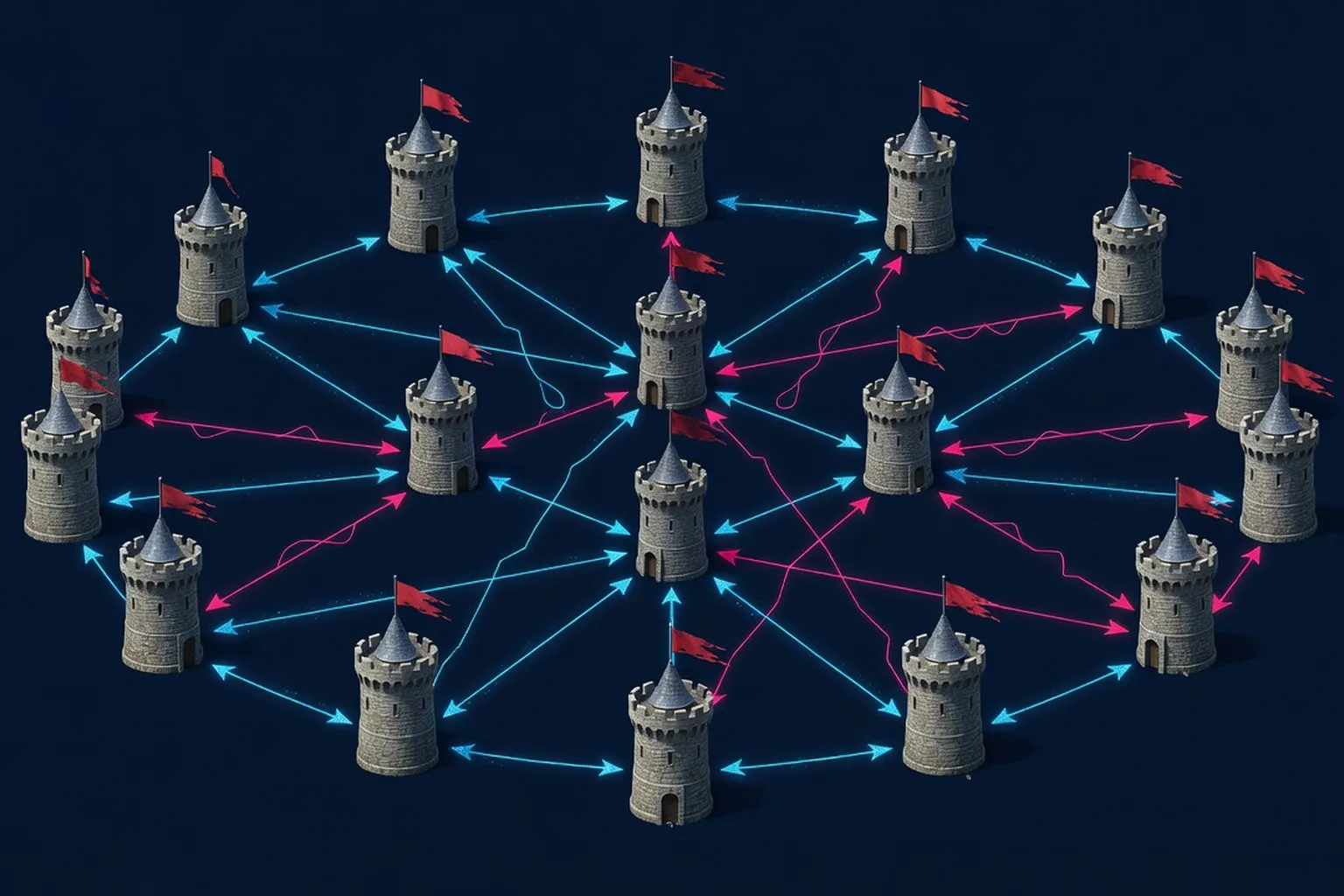
The Byzantine Generals Problem

Why this paper matters
The Byzantine Generals Problem (1982) is foundational to distributed systems theory, establishing the limits of fault tolerance in asynchronous, message-passing environments. Historically, it formalized the challenge of reaching consensus despite arbitrary failures-including malicious actors-that distort communication. Before Lamport et al., resilience in distributed systems was treated heuristically; this paper introduced a rigorous model that quantified when agreement is possible and impossible. The 1982 result-that oral-message consensus requires more than two-thirds loyal participants-was a shock to system designers, who assumed simple majority voting sufficed. The paper also introduced the “oral message” and “written message” models, which remain the canonical abstractions for studying Byzantine faults. In 2026, its influence is pervasive: every consensus protocol, from crash fault-tolerant (CFT) to Byzantine fault-tolerant (BFT), traces its lineage to this work. Modern cloud databases, blockchain systems, and even AI agent orchestration rely on the core insight that distributed agreement requires redundancy and redundancy requires quorum sizing. The paper’s mathematical framing of “traitorous” behavior also seeded later work on security, where faulty nodes can be adversarial rather than just failing. Without this paper, modern systems like Spanner or CockroachDB would lack formal guarantees for global consistency under network partitions or malicious intrusions.
The generative AI era has only amplified the paper’s relevance. Today’s AI agents, vector databases, and LLM serving stacks operate in distributed, multi-tenant environments where nodes may fail arbitrarily or act maliciously. The Byzantine Generals Problem provides the theoretical scaffolding to reason about trust, consistency, and agreement in these systems. Its quorum-based approach underpins everything from blockchain consensus to the design of robust AI pipelines, ensuring that even when individual components lie or fail, the system as a whole can still converge on a correct state. In AI safety, the problem is no longer abstract: a single compromised agent or corrupted embedding can derail an entire reasoning chain. The paper’s formalism offers a language to articulate these risks and design countermeasures.
Key contributions
- Formalized the Byzantine Generals Problem: a precise model of distributed consensus under arbitrary node failures and malicious behavior.
- Proved impossibility for oral messages below n > 3t threshold (t traitors), showing consensus requires more than two-thirds loyal participants.
- Introduced the oral-message model (unauthenticated, potentially forged messages) and the stronger written-message model (unforgeable signatures).
- Presented a recursive oral-message algorithm achieving consensus when n > 3t, establishing tight bounds for oral communication.
- Demonstrated that with unforgeable written messages, consensus is achievable for any n > t, eliminating the two-thirds requirement.
- Connected theoretical results to practical system design, arguing that Byzantine fault tolerance enables reliable distributed databases and networks.
Impact on modern systems
The Byzantine Generals Problem directly shaped modern distributed databases and consensus engines. FoundationDB (acquired by Apple, 2015) implements a BFT-inspired consensus layer, choosing a quorum size derived from the n > 3t bound to tolerate minority failures and network partitions. Its use of a transactional layer atop a fault-tolerant log demonstrates how practical systems operationalize the paper’s theoretical guarantees. CockroachDB (v20.2, 2020) uses a variant of Raft optimized for geo-distributed deployments, but its lease-based linearizability and failure detection are hardened by Byzantine-aware quorum logic to prevent split-brain under adversarial conditions. The system’s approach to range leases and epoch-based leadership reflects the need to bound the influence of faulty or compromised nodes, echoing the paper’s insistence on strict quorum sizing.
Spanner (Google, 2012) relies on TrueTime and Paxos for global consistency; while not BFT-native, its designers explicitly considered Byzantine behavior in wide-area clock synchronization and transaction ordering. The system’s use of externally consistent timestamps and lease management is a direct response to the challenges highlighted by Lamport et al.: how to agree on a global order when clocks drift and messages may be delayed or forged. Similarly, Google’s Bigtable (2006) predates Spanner but embeds consensus primitives in its tablet assignment and recovery logic, implicitly assuming that a majority of replicas are honest-a design choice grounded in the two-thirds bound. The paper’s influence extends to modern wide-area storage systems like Apache Cassandra, where the CAP theorem and quorum-based reads/writes reflect the same mathematical constraints, even when systems are not explicitly BFT.
The paper’s quorum intersection principle underpins modern gossip protocols in ScyllaDB (2015) and YugabyteDB (2018), where nodes exchange Merkle trees to detect divergence-an idea rooted in the need to detect traitorous or faulty replicas. These systems use Merkle proofs to verify state consistency across nodes, a technique that aligns with the written-message model’s requirement for unforgeable evidence. MongoDB’s causal consistency (5.0+, 2021) uses vector clocks derived from logical time models like Lamport’s Time, Clocks, and the Ordering of Events in a Distributed System (1978), extending the notion of event ordering beyond crash failures to include arbitrary message corruption.
Protocol design in production systems often embeds the n > 3t threshold indirectly. For instance, Kubernetes etcd (v3.3, 2019) defaults to a 3-node cluster to tolerate one failure, aligning with CFT assumptions. But when deploying BFT variants (e.g., using HashiCorp’s Raft with BFT extensions), operators increase cluster size to 4 or 7 nodes to absorb Byzantine behavior-echoing the paper’s exact constraint. The latency overhead of BFT consensus (typically 3-5x higher than CFT) is a direct consequence of the extra message rounds required to authenticate and verify loyalty under the oral-message model. Even systems like Redis (v7.0, 2022) with its Redis Cluster mode implicitly rely on quorum-based failover, where the paper’s impossibility results inform operator practices for cluster sizing and failure handling.
Blockchain systems like Tendermint (2014) and Hyperledger Fabric (2017) explicitly adopt BFT consensus to tolerate malicious validators, with validator sets sized to satisfy n > 3t. These systems use cryptographic signatures and Merkle trees to implement the written-message model, ensuring that messages cannot be forged-a direct evolution of the paper’s theoretical framework. The LSM-tree design used in systems like Apache Cassandra and ScyllaDB also reflects Byzantine-aware thinking: write-ahead logs and compaction strategies are engineered to detect and repair divergence, a form of self-healing that assumes the possibility of corrupted or faulty replicas. This mirrors the paper’s recursive algorithms for detecting and expelling traitors from the consensus process.
Even in systems not labeled BFT, the paper’s shadow looms. Dynamo-style systems (e.g., Amazon Dynamo (2007)) use sloppy quorums and hinted handoff to mask temporary failures, but their anti-entropy protocols implicitly assume that a majority of replicas are honest-an assumption grounded in the two-thirds bound. When Cassandra clusters face network partitions or misconfigured nodes, the system can degrade into a state where the paper’s impossibility result applies unless operators intervene manually. This vulnerability has led to production incidents where inconsistent reads or split-brain scenarios emerge, reinforcing the need for Byzantine-aware designs even in systems originally built for crash tolerance.
AI era: how LLMs and vector databases relate to this paper
Vector databases (Pinecone, Weaviate, Qdrant, pgvector, Milvus) and Retrieval-Augmented Generation (RAG) pipelines inherit the Byzantine Generals Problem in two critical ways: state consensus and semantic integrity. In multi-agent AI systems, where agents collaborate via message passing (e.g., tool calls, embedding sharing, or planning logs), the risk of “traitorous” agents-those injecting poisoned embeddings, hallucinated facts, or misleading vectors-mirrors the generals’ dilemma. A single adversarial agent can destabilize a vector index by corrupting similarity search results, leading to inconsistent retrieval and downstream hallucinations in LLM responses. This is the oral-message model in practice: messages (embeddings, metadata, or retrieval tokens) are unverified and forgeable unless signed or hashed.
RAG systems built on top of distributed vector stores (e.g., Weaviate clusters across regions) must handle partial failures and adversarial nodes. The paper’s n > 3t rule translates to quorum requirements for embedding ingestion and query routing. If a cluster of 7 vector nodes tolerates 2 failures under CFT (Raft/Paxos), it may not tolerate a single Byzantine node injecting adversarial vectors unless additional authentication (e.g., Merkle proofs, vector signatures) is used-echoing the written-message model. Systems like Milvus and Qdrant have begun integrating vector signatures and cryptographic hashes to bind embeddings to provenance, reducing forgeability. For example, Qdrant’s recent “payload signatures” feature ensures that vector data and its metadata are cryptographically linked, preventing tampering by malicious nodes. Pinecone’s “consistency levels” (strong, bounded, eventual) further illustrate the quorum trade-offs, where stronger consistency requires larger quorums and higher latency-directly reflecting the paper’s impossibility results.
LLM inference latency is also impacted by Byzantine-aware consensus. In federated inference systems, where multiple model replicas serve predictions, the need to agree on a final output under malicious replicas introduces extra rounds of verification-analogous to oral-message consensus. This inflates end-to-end latency, a known bottleneck in production LLM serving (e.g., vLLM, TensorRT-LLM) when deployed in adversarial or unreliable networks. Recent work on “Byzantine-robust aggregation” in federated learning (e.g., Krum, ByzantineSGD) applies similar filtering to gradients; these ideas are now being ported to RAG pipelines to filter out adversarial vectors. For instance, systems like LlamaIndex now include “Byzantine filtering” steps in their retrieval pipelines to discard outliers or inconsistent embeddings before they reach the LLM. The rise of “mixture-of-experts” (MoE) models like Mixtral 8x7B further compounds the problem: if even one expert is compromised, it can poison the entire inference path, requiring Byzantine-tolerant routing protocols to mitigate.
Semantic indexing and agent state stores face a related challenge. When agents store intermediate reasoning traces or vectorized context in shared stores, the system must ensure that the state remains consistent even if some agents are compromised. Emerging systems like Redis with vector extensions or custom state stores now incorporate Merkle trees and vector clocks to detect divergence-directly inspired by Virtual Time and Global States of Distributed Systems (1985), which extends the paper’s ideas to observational consistency. In AI agent frameworks like LangChain or CrewAI, the “planner” component acts as the general, while tools and memory stores act as lieutenants. If the planner receives conflicting state from different components, it must reach agreement-a process that implicitly relies on quorum-based logic akin to n > 3t.
Finally, LLM-driven query planning in distributed databases (e.g., AI agents choosing which shards to query) reintroduces the generals’ dilemma at a higher semantic layer. If the planner is an LLM, it may receive conflicting metadata from different shards (e.g., stale versions, corrupted stats). Ensuring the planner reaches a correct global plan requires agreement protocols-again invoking the n > 3t logic. This is why systems like YugabyteDB have begun experimenting with AI-assisted consistency checks, where an LLM verifies quorum intersections before committing a distributed transaction. In these systems, the LLM acts as a “general” that must reconcile conflicting reports from potentially untrustworthy “lieutenants,” a modern instantiation of the paper’s classic problem. The shift toward “agentic databases” where LLMs orchestrate transactions across shards makes the Byzantine Generals Problem a first-class concern in database design, not just a theoretical curiosity.
The generative AI stack’s reliance on distributed, multi-agent architectures means the Byzantine Generals Problem is no longer confined to systems engineering-it is now a first-class concern in AI safety and reliability. Whether ensuring that a vector database returns trustworthy results or that an AI agent’s planning decisions are consistent across replicas, the paper’s insights provide the theoretical foundation for building robust, adversary-resilient AI systems. The challenge is no longer just about tolerating crashes or network partitions; it is about tolerating malice, deception, and semantic corruption at scale.
Further reading
- Byzantine Fault Tolerance (MIT 6.824 course notes)
- Practical Byzantine Fault Tolerance (Castro & Liskov, 1999)
- Consensus in the Presence of Partial Synchrony (DLS, 1988)
- How FoundationDB Uses Consensus (Apple Engineering Blog)
- The Part-Time Parliament (Lamport, 1998)
- [Relational model as a stable baseline for distributed consensus design]
- Eventual Consistency Revisited (Vogels, 2009)
- LSM-Tree: A Technique for Implementing High-Performance Key/Value Stores (O’Neil et al., 1996)