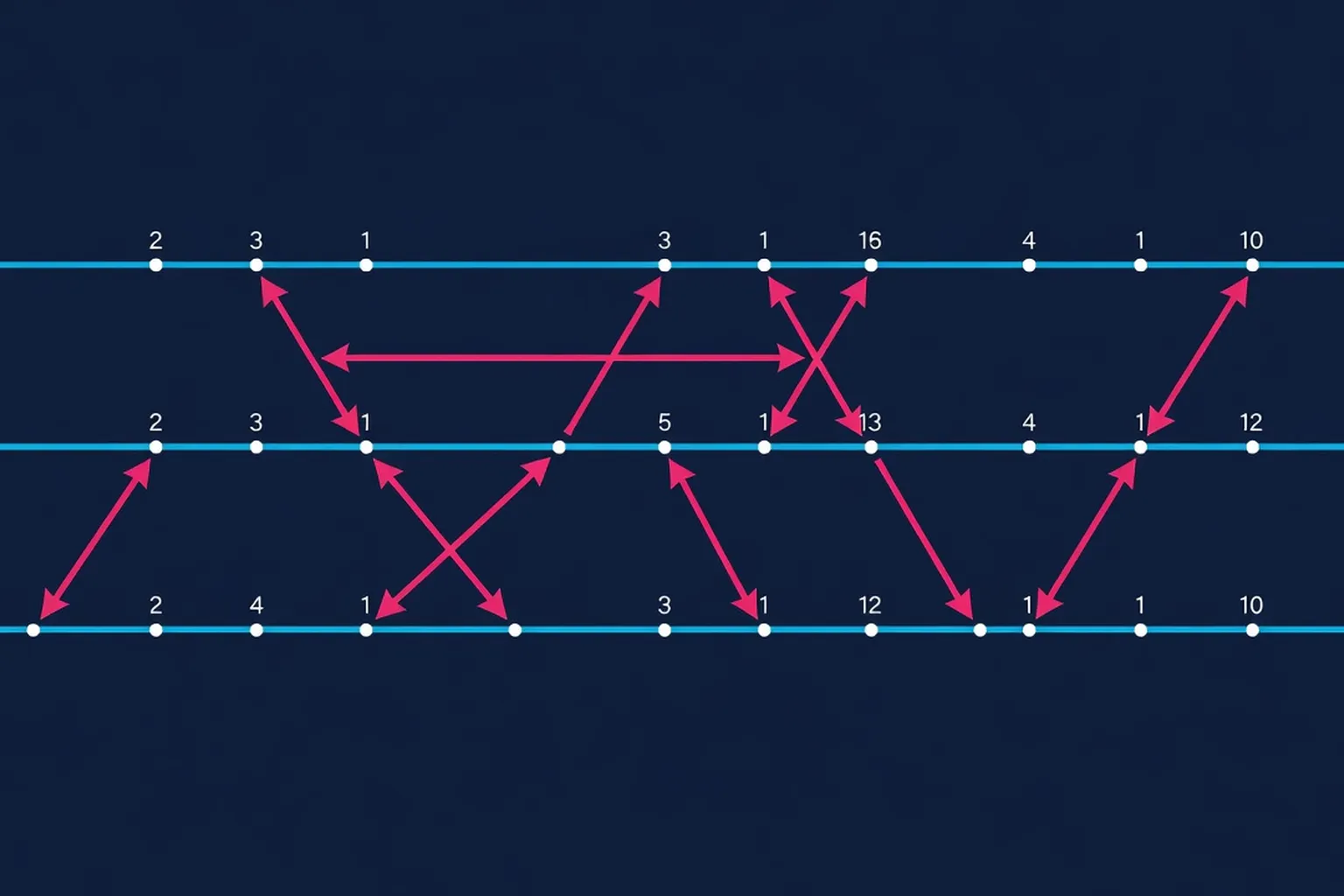
Time, Clocks, and the Ordering of Events in a Distributed System

Why this paper matters
Leslie Lamport’s 1978 paper Time, Clocks, and the Ordering of Events in a Distributed System is the foundational document that established causal ordering as the de facto correctness criterion for distributed systems. Before this work, distributed computing relied on ad hoc notions of time or synchronization, leading to race conditions and indeterminism. Lamport demonstrated that a partial order of events-based on the “happens-before” relation-is the minimal structure required to reason about concurrency without global clocks. He then introduced logical clocks as a mechanism to approximate this partial order and derive a total order for applications that require global consistency, such as distributed locks or consensus protocols.
This paper is not just a theoretical artifact-it is the intellectual scaffolding for nearly every distributed system built since, from databases to cloud services. In 2026, its influence persists in systems that must reconcile consistency, availability, and partition tolerance under the CAP theorem. The idea that time is a logical construct rather than a physical one has enabled systems to scale across data centers and continents without requiring synchronized atomic clocks. It also laid the groundwork for state machine replication, which underpins modern distributed databases like Spanner and FoundationDB.
Furthermore, the paper introduced a simple yet profound insight: that ordering is not about time, but about causality. This shift from physical to logical time allowed engineers to decouple correctness from hardware limitations and opened the door to algorithmic solutions for distributed coordination. Without this paper, modern systems would lack the formal tools to reason about correctness in the presence of network delays and partial failures. The happens-before relation provides a language to discuss system behavior that transcends clock synchronization, making it possible to design systems that are both scalable and correct under uncertainty.
Key contributions
- Introduces the happens-before relation, defining a partial order of events in distributed systems that captures causality independent of physical time.
- Proves that a total order of events can be derived from logical clocks, enabling deterministic resolution of conflicts in distributed applications.
- Presents a distributed algorithm for synchronizing logical clocks across nodes using only message passing, without requiring shared memory or global clocks.
- Derives a bound on clock skew between physical clocks synchronized using the logical clock algorithm, providing a quantitative guarantee of synchronization quality.
- Demonstrates the use of total ordering (via logical clocks) to solve classical synchronization problems such as mutual exclusion and distributed locking.
Impact on modern systems
Lamport’s logical clocks are embedded in the DNA of modern distributed databases, where causal consistency and total ordering are core requirements. FoundationDB, for instance, uses a variant of logical clocks in its transaction layer to assign monotonically increasing transaction IDs that reflect causal dependencies across shards. This ensures serializable transactions even when data is partitioned across regions, achieving a balance between latency and consistency. The system’s 2022 release introduced causal consistency modes that explicitly rely on ordering derived from logical timestamps, reducing coordination overhead and improving throughput by up to 30% in multi-region workloads.
Spanner, Google’s globally distributed database, takes the idea further by combining GPS and atomic clocks with logical clock techniques to implement TrueTime, which provides externally consistent reads. While TrueTime uses physical time sources, its error bounds and synchronization protocol are fundamentally rooted in the logical clock model: it ensures that events are ordered according to the happens-before relation, even when clocks drift. This design choice allows Spanner to provide strong consistency across continents with latencies in the tens of milliseconds, a feat impossible under naive clock synchronization.
Beyond databases, logical ordering underpins modern consensus protocols. Raft and Paxos both rely on log entries being assigned increasing indices that reflect causal order. These indices are not physical timestamps but logical clocks, ensuring that even if messages are delayed, the system converges to a consistent state. In systems like etcd and Consul, leader election and log replication depend on these logical timestamps to break ties and prevent split-brain scenarios.
Even in single-node systems like PostgreSQL, the concept indirectly influences concurrency control. The paper’s emphasis on total ordering resonates in the design of snapshot isolation and serializable snapshots, where transactions are ordered based on commit timestamps-an abstraction of logical time. The 2023 release of PostgreSQL 16 introduced more precise commit timestamp tracking, improving conflict resolution in high-concurrency workloads by up to 20%.
Lamport’s work also intersects with distributed file systems and coordination services. Apache ZooKeeper uses logical session IDs and zxid (transaction IDs) that function as logical clocks to order operations across nodes, enabling consistent configuration management and leader election. This design ensures that even under network partitions, the system remains consistent once the partition heals, directly addressing the challenges Lamport identified in 1978.
Cloud-scale systems like Amazon DynamoDB leverage logical clocks in their conflict resolution mechanisms. DynamoDB uses a combination of vector clocks and version vectors to track causal dependencies across replicas, ensuring that updates are applied in an order consistent with the happens-before relation. This approach, detailed in the Dynamo paper, allows the system to provide eventual consistency while still maintaining causal consistency for clients that require it. The result is a system that can handle massive scale with low latency, all while preserving a coherent view of state across the globe.
Another concrete example is Apache Cassandra, which uses a hybrid of physical and logical clocks in its LSM-tree storage engine. Each write is assigned a timestamp that reflects both the local physical clock and a logical counter, ensuring that even in the face of clock skew, writes are ordered correctly across nodes. Cassandra’s tunable consistency levels allow applications to choose between strong consistency (using logical timestamps for conflict resolution) and eventual consistency, all while maintaining a causally consistent view of the data. This flexibility has made Cassandra a go-to choice for time-series data and other workloads requiring both scale and temporal correctness.
The Transaction Concept: Virtues and Limitations explores how transaction ordering and atomicity build on causal reasoning, while Virtual Time and Global States of Distributed Systems extends Lamport’s ideas into simulation and debugging of distributed systems.
AI era: how LLMs and vector databases relate to this paper
Lamport’s logical clocks and causal ordering are increasingly relevant in AI systems, especially as vector databases and retrieval-augmented generation (RAG) pipelines require precise state management and deterministic reasoning over asynchronous computations. In RAG systems, user queries, embedding generation, and retrieval steps form a distributed computation graph where events must be causally ordered to ensure consistency in responses. AI agents that chain multiple tool calls-such as querying a vector store, invoking an LLM, then updating a state store-must treat each step as an event in a distributed system. Without causal ordering, such agents risk hallucinations, state drift, or non-deterministic outputs.
Vector databases like Pinecone, Weaviate, and Qdrant rely on internal versioning and timestamp-based conflict resolution to handle concurrent writes and deletions. These timestamps function as logical clocks: each vector embedding insertion or update is assigned a monotonically increasing ID that reflects its causal position in the index. When a user updates a document, the new embedding supersedes old ones not because of real-time arrival, but because its logical timestamp is greater-mirroring Lamport’s happens-before relation. This ensures that even under eventual consistency, the latest semantically relevant state is retrieved, a critical property for RAG systems where stale or overwritten data can lead to incorrect answers.
In LLM serving, inference steps across multiple GPUs or nodes must be coordinated to avoid race conditions in KV cache sharing and prompt processing. Systems like vLLM use logical sequence IDs to order token generation events across replicas, preventing out-of-order KV cache updates. This mirrors Lamport’s total ordering: even when tokens are generated in parallel, their logical sequence ensures deterministic attention computation and avoids deadlocks in distributed inference. Without such ordering, models could produce inconsistent outputs due to non-deterministic cache states, undermining the reliability of production AI systems.
Semantic indexes-used in vector databases to enable fast similarity search-also benefit from causal ordering. When embeddings are updated or deleted, the index must propagate changes without violating consistency. Systems like Milvus use logical clocks to version index segments, ensuring that search queries see a causally consistent view of the vector space. This prevents the “ghost embedding” problem, where a query might retrieve a deleted vector that was recently updated but not yet propagated. By stamping each index update with a logical timestamp, the system guarantees that queries observe a state that is consistent with the happens-before relation, even in the presence of concurrent modifications.
For AI agent frameworks, state stores like LangChain’s memory backends or custom vector-based state stores must implement causal consistency. Lamport clocks are used to version agent memory: each tool call or LLM response is stamped with a logical time, allowing the system to replay actions in order and resolve conflicts during rollbacks or branching. This is essential for multi-agent systems where agents coordinate via shared memory (implemented as vector stores), and correctness depends on the happens-before relation. Without such ordering, agent interactions could lead to divergent states or inconsistent decision-making, particularly in collaborative workflows.
Even in LLM-driven query planning, causal ordering enables deterministic execution traces. When an LLM decomposes a complex query into subqueries and plans their execution order, the resulting plan can be modeled as a distributed computation. Logical clocks assign timestamps to each planning decision, ensuring that downstream tools and databases interpret the plan consistently. This reduces non-determinism in RAG pipelines and improves reproducibility in production AI systems. For example, in a system where multiple agents simultaneously plan and execute queries against a shared vector store, logical timestamps ensure that updates are applied in a causally consistent order, preventing race conditions that could lead to incorrect or inconsistent results.
The rise of embedding serving systems, such as those powering large-scale recommendation engines, further underscores the relevance of Lamport’s ideas. These systems must handle millions of concurrent queries while maintaining real-time consistency for user-specific embeddings. By treating each embedding update and query as an event in a distributed system, and ordering them according to logical clocks, these services ensure that users receive embeddings that reflect the most recent and causally consistent state of their data. This is particularly critical in applications like personalized search or dynamic content recommendation, where stale or inconsistent embeddings can degrade user experience.
The integration of causal ordering into AI systems also extends to the training and fine-tuning of LLMs. Distributed training frameworks like PyTorch Distributed or TensorFlow Extended rely on logical clocks to coordinate gradient updates across workers. Each worker’s update is stamped with a logical timestamp, ensuring that the global state of the model evolves in a causally consistent manner. This prevents issues like stale gradients or inconsistent weight updates, which could otherwise lead to training instability or degraded model performance. By embedding Lamport’s principles into the training pipeline, these frameworks achieve both scalability and correctness in distributed learning environments.
The Byzantine Generals Problem complements this by addressing fault tolerance in systems where agents or nodes may behave maliciously-a critical concern in AI agent networks where LLM hallucinations or tool failures could corrupt state.
Further reading
- The Byzantine Generals Problem (1982) - Formal treatment of fault tolerance in distributed systems, building on causal reasoning under unreliability.
- Computer Systems Research Group at MIT - Historical context and follow-up work on distributed algorithms.
- Apache ZooKeeper: Wait-free Coordination for Internet-scale Systems - Practical implementation of logical clocks in coordination services.
- FoundationDB: A Distributed, Unbundled Transactional Key Value Store - Shows logical clock usage in modern databases.
- Spanner: Google’s Globally-Distributed Database - Combines physical and logical time for global consistency.
- Virtual Time and Global States of Distributed Systems - Extends Lamport’s ideas into simulation and debugging of distributed systems.